Most clinicians view manual muscle testing as a rudimentary gauge of physical strength or structural power. But when performed with appropriately, this hands-on evaluation transforms into something far more profound: an immediate readout of your patient's capability to withstand external force.
Beyond the Machine: Where the Magic of Neurological Control Happens
In modern rehabilitation, we are surrounded by sophisticated machinery. We have computerised isokinetic dynamometers and force plates that can accurately quantify concentric, eccentric, and isometric contractions down to the exact foot-pound of torque. These machines are exceptional at measuring the physical "hardware" of a muscle. They tell you what a tissue can do under a fixed, predictable load.
But the real world doesn't operate in a straight, predictable line. When a patient slips on a wet curb, missteps off a stair, or reaches to catch a falling object, their survival depends entirely on their nervous system's capacity to adapt mid-flight. In a fraction of a second, the relevant muscles must instantly transition from an isometric hold to an eccentric deceleration, and immediately snap into a concentric stabilisation.
No machine on earth can measure this transitional fluid transition. Only a masterfully applied manual muscle test can evaluate a patient's capability to seamlessly shift between these distinct contraction types under an unpredictable, changing force. That precise crossroad is where the magic of real-time neurological control happens.
Re-Defining Health as the Capacity to Withstand Force
We often define health by what is missing, the absence of disease, the absence of pain, or the absence of structural damage on an MRI. But Afferentology defines health by what is present: the active capacity to adapt to environmental stress without breaking. If a joint cannot dynamically shield itself from a sudden, external force, injury is not a possibility; it is a mathematical certainty.
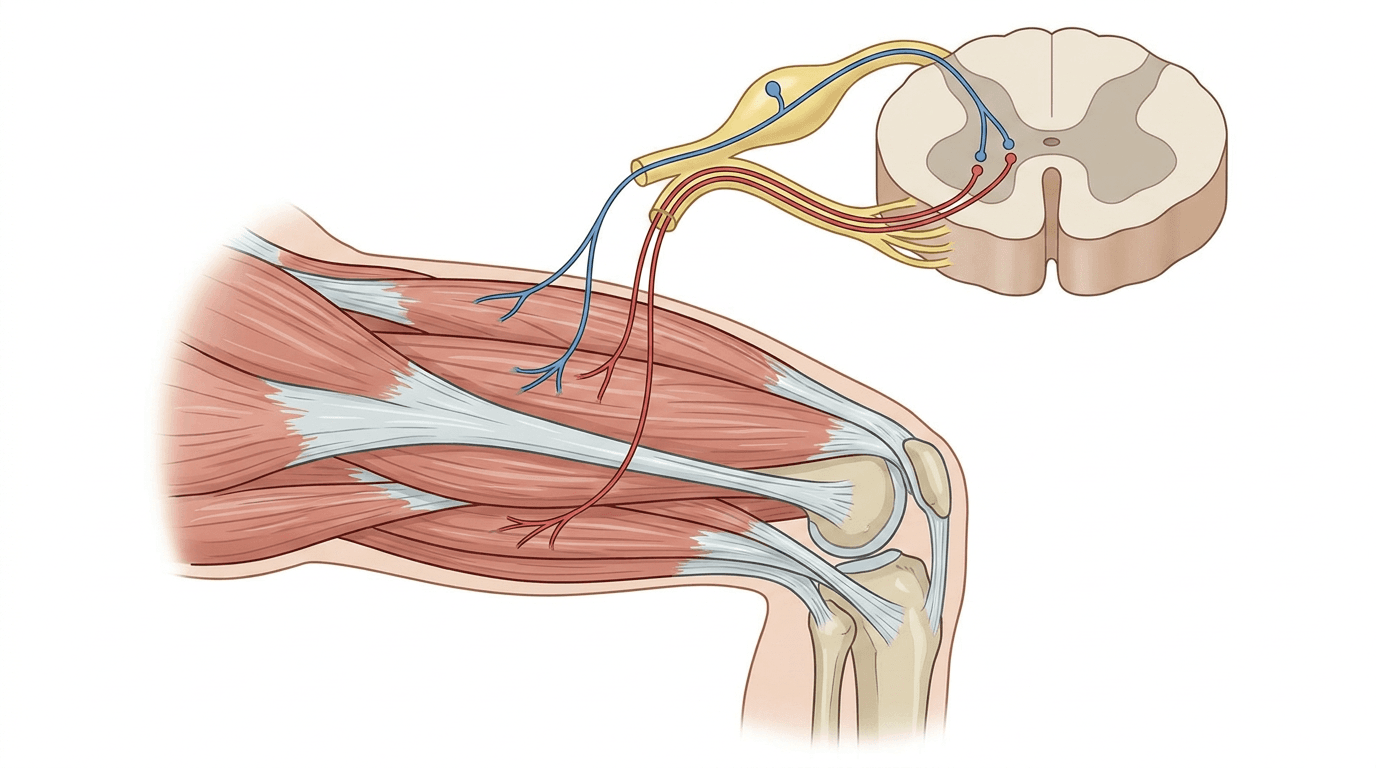
Every single muscle in the human body relies on an automated baseline motor neuron output to maintain structural stability. When the central nervous system is functioning optimally, it acts like a high-speed processor, continuously summing thousands of sensory inputs to maintain a healthy resting tone. It ensures that when a manual force is applied at the table, the muscle doesn't just resist; it dynamically facilitates its tone to meet and overcome the challenge instantly.
The Ultimate Health Test: If a muscle collapses under a properly applied manual challenge, it is not because the physical fibres are suddenly too weak or deconditioned. It is a sign that the motor neuron has been pushed into a state of neurological inhibition. The muscle has lost its defensive shield. Testing this response isn't just checking a muscle's power, it is auditing the functional integrity of the entire reflex loop.
When you perform a manual muscle test this way, you are no longer just looking at a local shoulder or hip problem. You are evaluating the fundamental health of the organism: its capacity to process sensory data, coordinate a motor response, and successfully protect its own structural framework from the forces of the outside world.
The withdrawal reflex and the Illusion of Tightness
When a sensory insult like an old, unhealed scar, a misaligned jaw contact, or a deep fascial restriction, broadcasts an irritating signal into the nervous system, the system initiates a survival protocol. It triggers reflexes which protect the body from further injury.
This reflex pattern actively suppresses the motor neuron output to the associated prime movers, causing them to fail a manual muscle test instantly. Sometimes, the antagonists muscle are activated, locking them into a permanent, painful state of hypertonic contraction to brace the vulnerable joint.
When a patient presents with a chronically "stiff neck" or "tight hamstrings," the conventional clinician steps in with a hardware mindset, stretching the tight tissue and forcing the weak muscle through rigid exercise protocols. But if active reflexes are intentionally keeping that muscle inhibited as a result of abnormal or bad inputs, exercising it will only cause further breakdown. By identifying the sensory short-circuits via precise manual testing, you can clear the reflex interference, instantly restore full muscle strength, and bring the deep protective software back online.
Clinical Takeaways for the Progressive Practitioner
- Manual muscle testing evaluates transition, not just force: The true magic of the test lies in assessing how effectively the nervous system can switch between concentric, eccentric, and isometric states against an unpredictable load.
- Inhibition is a software failure, not a hardware defect: A muscle that gives way during a precise manual test isn't necessarily small or deconditioned; its baseline motor neurons have been actively turned down by a protective reflex.
- True health is the ability to withstand external forces: Assessing a patient’s capacity to dynamically adapt and resist injury at the table provides an objective window into their systemic functional health.
- Sensory input dictates motor output: You cannot permanently restore muscle power, stabilise posture, or improve flexibility until you find and clear the underlying sensory irritant that is forcing the nervous system to protect itself.
A muscle test is never just about the muscle. It is a live interrogation of the nervous system's capacity to adapt.
When you master the art of the manual muscle test, you step past the limitations of static imaging and machine analytics. You gain the clinical toolset required to audit the software of human movement in real time—enabling you to instantly facilitate strength, eliminate compensation, and guide your patients toward true, long-term functional robustness.