To navigate an unpredictable and sometimes dangerous environment, our sensors require direct, autonomous control over our muscle tone. In Afferentology, we call this the "Survival Override."
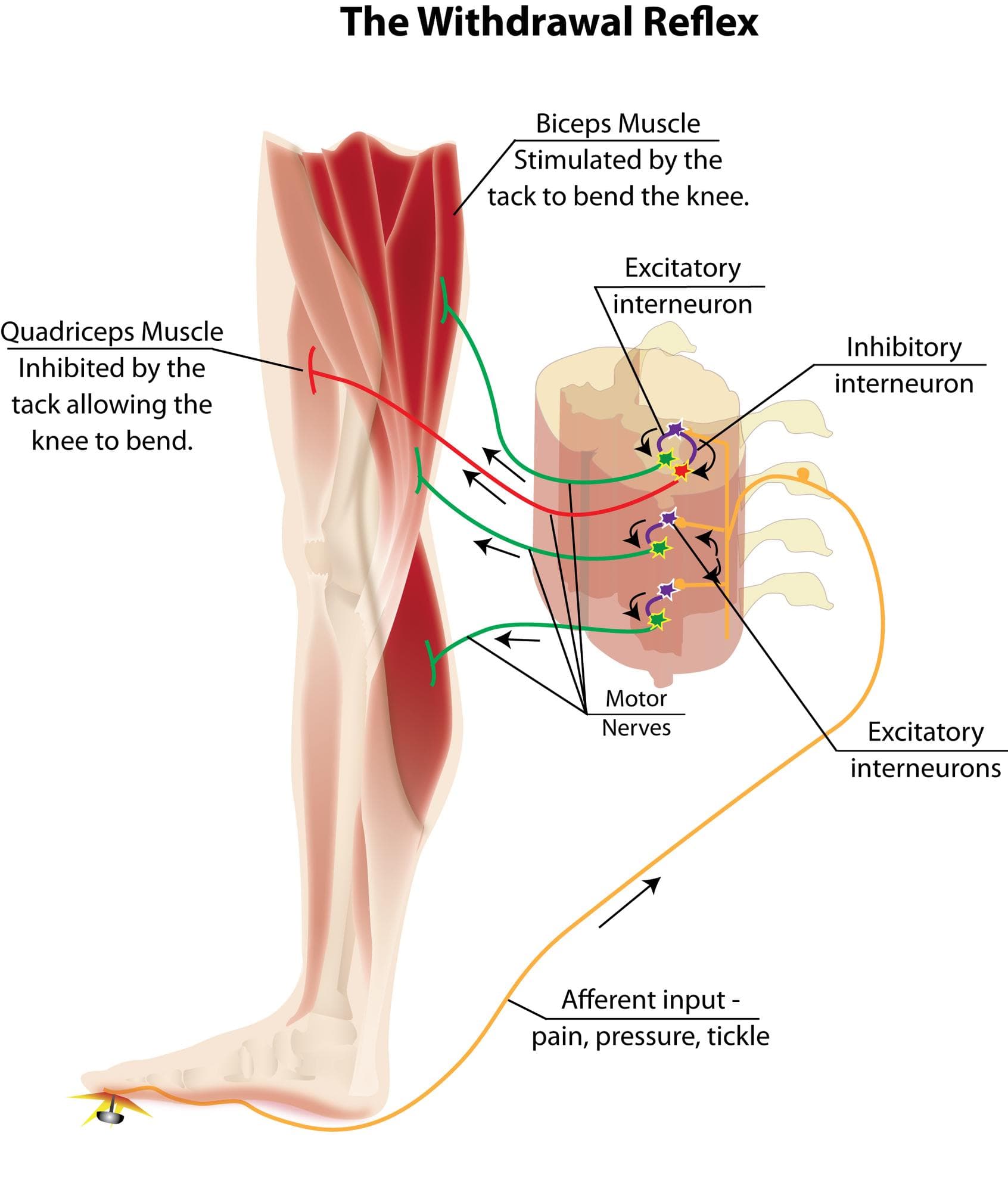
When you touch a hot iron, nerve messages race up your arm and into your spinal cord. They connect directly to the motor neurons that contract the muscles, pulling your hand away before your brain even registers the heat. This is the Withdrawal Reflex—a hard-wired circuit designed to protect the hardware at all costs.
Immediate Protection Without Thinking
Without this direct connection between your skin and your muscles, the pain warning would have to travel all the way to the brain, be interpreted, and wait for a conscious command. Those lost milliseconds are the difference between a minor startle and a third-degree burn. The reflex bypasses the "CPU" of the brain to ensure the integrity of the system.
"If you stand on a nail, pain sensors fire, causing an immediate contraction of the hamstrings and hip flexors. Simultaneously, the antagonists are inhibited, preventing you from pushing your foot further through the nail. The software has taken control."
Beyond Pain: The "Silent" Withdrawal
While we recognize the reflex in extreme pain, it operates throughout the body in response to any persistent irritation. A pebble in your shoe may not 'hurt,' but it forces a limp. Your nervous system hates irritation; it requires the skin to be free of insult to maintain a clean resting tone.
Crucially, the reflex has priority over your brain's conscious instruction. This is why it is physically impossible to force yourself to hold your hand on a red-hot iron. The survival software outranks the conscious user.
The Modern "Nail": Piercings and Scars
Our skin is sensitive enough to feel a single hair move. When our sensors are alerted to irritation, they ready us for action by changing our muscle tone. In the modern world, this irritation often comes from intentional foreign bodies or surgical trauma.
Case Study: The Belly Piercing and the Back Sprain
A piercing near the belly button can constantly activate the abdominals while inhibiting the spinal extensors. You may feel "normal" until you lift a heavy load, at which point the inhibited extensors fail to protect the spine. Unless the "Nail" (the piercing) is addressed, the back pain remains a software glitch that no amount of physical therapy can override.
Afferentology: The Common Language of Therapy
Afferentology provides a scientific framework for the beneficial effects of all physical therapies—from Chiropractic and Physiotherapy to Acupuncture and Reflexology. Any practitioner who touches, moves, or manipulates a patient is effectively reprogramming the patient's afferent input.
- Reflexology: Stimulating receptors in the feet to facilitate or inhibit tone throughout the body.
- Acupuncture: Inducing a specific, powerful withdrawal reflex through the stimulation of free nerve endings.
- Manual Therapy: Adjusting joints to clear the "noise" from mechanoreceptors, allowing the resting tone signal to stabilize.
Foreign Bodies and Long-Term Stability
If a nail in the foot induces the withdrawal reflex, a "nail" (earring) through the ear or nose must do the same. It is impossible for a foreign body not to induce changes in muscle tone as the body withdraws from the irritant.
Once we understand that these neurological shifts are inevitable, it becomes medically negligent not to examine for them in any case of chronic muscular inhibition.
Learn to Identify and Address Withdrawal Reflex Issues
Discover how to examine muscle tone and identify sources of nerve interference affecting your patients.