The Architect of Orofacial Neuroscience: Who is Mats Trulsson?
Professor Mats Trulsson, of the Department of dental Medicine at the Karolinska Institutet, has spent his career listening to the "conversations" between our teeth and our brains. While traditional dentistry focuses on the hardware—the enamel, the dentin, and the titanium of implants—Trulsson’s work has been a deep dive into the software. Through a rare and precise technique called microneurography, he has been able to tap into the inferior alveolar nerve of awake humans to record the electrical impulses sent to the brain during the simple act of biting.
Department of Dental Medicine, Karolinska Institutet
The 50hz Resting Tone: Your Brain’s Internal Voltmeter
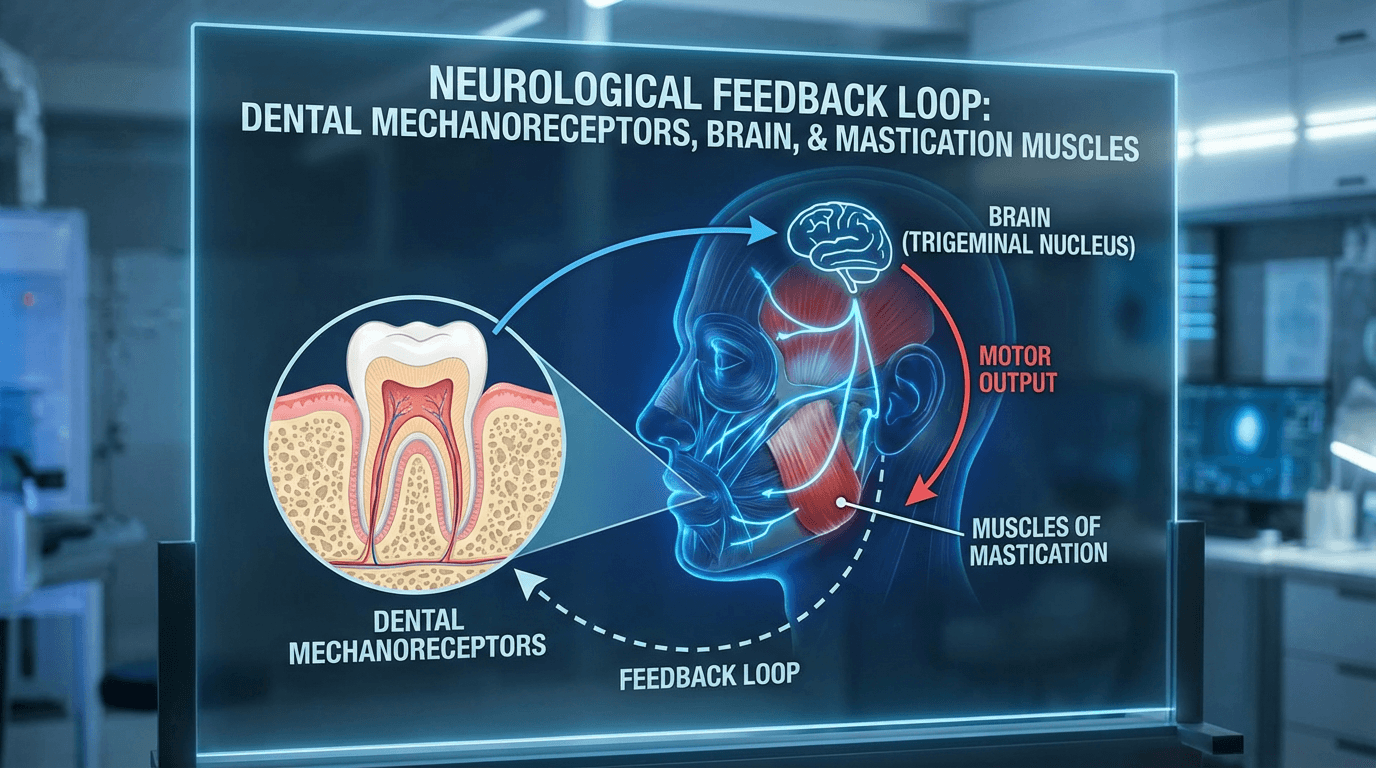
Trulsson’s most startling discovery is that our teeth are never truly "silent." His recordings revealed that the Periodontal Mechanoreceptors (PMRs) maintain a baseline of electrical activity—a 50Hz resting tone. This isn't just background noise; it is a calibrated signal that keeps the brain’s "neurological voltmeter" active and ready. This constant stream of data allows the brain to detect even the slightest deviation in pressure, such as a single hair or a grain of sand between your molars.
"Think of your teeth not as tools for crushing, but as the 'fingertips' of your face. Trulsson’s research shows that without the precise data from these receptors, the brain is effectively biting in the dark."
The "Nail in the Foot" and the withdrawal reflex
In Afferentology, we often use the Nail in the Foot analogy to describe how the brain reacts to corrupted data. Trulsson’s microneurography research provides the clinical evidence for this. He found that these receptors are most sensitive to forces under 1N. When the tooth detects an unexpected sharp object, the "voltmeter" spikes, triggering an immediate Withdrawal Reflex in the jaw muscles. This is a survival mechanism: the brain prioritizes protecting the "hardware" (the tooth) by instantly inhibiting the "software" (the muscle output).
Hardware vs. Software: The Implant Dilemma
Trulsson’s work highlights a critical gap in modern oral rehabilitation. When we replace a natural tooth with a titanium implant, we replace the hardware but lose the software. Because implants lack the periodontal ligament, they cannot produce the 50Hz resting tone. Trulsson found that implant patients use significantly higher and more erratic biting forces because their brain has lost its primary source of Afferent feedback. The system is "blind," leading to chronic instability and a loss of fine motor control.
Clinical Takeaways: The Afferentology Perspective
- Data Over Diagnosis: Chronic jaw pain or instability is often a "software" issue—corrupted afferent data—rather than a "hardware" failure in the joint or bone.
- The 20% Rule: Up to 20% of your jaw’s muscle activation is driven directly by sensory feedback from the teeth. Loss of this signal equals loss of function.
- Task-Specific Loops: The brain uses "Directional Tuning" from teeth to calculate the exact vector of a bite. If these loops are disrupted, the entire system enters a state of neurological "noise."
- Cognitive Connection: Trulsson’s recent findings suggest that maintaining this oral "software" is vital for brain health, with strong links between chewing efficiency and the prevention of cognitive decline.
By understanding the work of Mats Trulsson, we move beyond treating symptoms and begin treating the system. We aren't just fixing teeth; we are restoring the signal to the most complex computer in the world: the human brain.