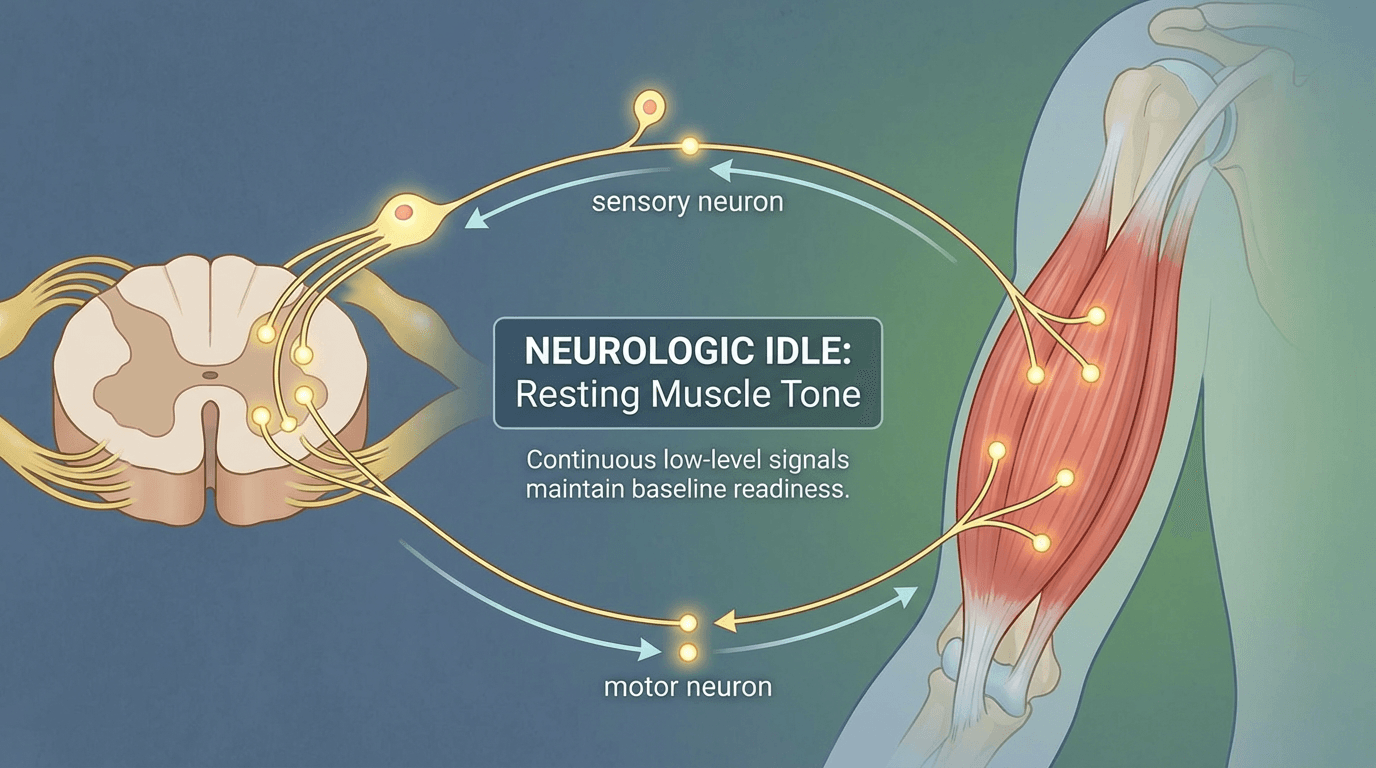
The common idea of "correcting muscular imbalances" misses the neurological reality: your muscle tone is a reflex, not a choice
The 50hz Tone: The Spinal Cord’s "Neurologic Idle"
We’ve all been told the story of "weak" glutes or "tight" hip flexors. The prescribed fix is almost always the same: a series of stretches and strengthening exercises designed to manually rebalance the body. Yet, for many, the tension returns the moment they stop moving. This is because muscles don't possess a mind of their own; they are the end-stage execution of a complex reflex system managed within the Central Nervous System (CNS).
"The vast majority of muscle tone is managed at the level of the spinal cord. This is the home of the 50Hz resting tone—the 'neurologic idle' that ensures your muscles maintain a baseline of readiness even at rest."
This constant stream of data travels from the muscle spindles to the cord and back again. This isn't a voluntary action; it is a cord-based reflex loop. When this loop is clear, the body stays balanced. But when the spinal cord receives "noisy" or threatening data from an Afferent source, it must make an immediate decision to protect the system.
Cord-Based Reflexes: The Real-Time Decision Makers
The spinal cord is not just a relay station; it is a processing center capable of independent action. Through propriospinal tracts, the cord coordinates movement across multiple levels of the spine simultaneously. When an irritant—the Nail in the Foot—is introduced, the spinal cord triggers a withdrawal reflex.
This is a hard-wired survival mechanism that bypasses the "slow" conscious brain to provide an instant response. The spinal cord immediately alters the 50Hz tone to inhibit one muscle and facilitate another. This is the origin of what we call an "imbalance," but in reality, it is a brilliant, cord-based survival strategy.
Why Traditional Care Often Fails the "Software"
Traditional physical therapy and exercise are often extrinsic—they attempt to change the muscle from the outside. However, if the spinal cord has decided that a muscle should be inhibited to protect the system, no amount of "reps" will override that cord-based reflex for long.
- Inhibited Muscles: The cord "unplugs" the muscle. Strengthening it is like driving a car with the emergency brake on; you are fighting the system's own protective software.
- Facilitated Muscles: The cord "locks" a muscle into chronic tension as a brace. Stretching provides only temporary relief because the Withdrawal Reflex will re-tighten it to maintain safety.
- Precision Mapping: Afferentology uses Protective Reflex Testing to act as a Neurological Voltmeter, finding exactly where the signal is being corrupted.
Your body isn't "imbalanced" because you're lazy or weak; it’s imbalanced because your spinal cord is trying to protect you. By addressing the Afferent input and restoring the 50Hz idle, we allow the system to reset, moving you from a state of survival to a state of performance.