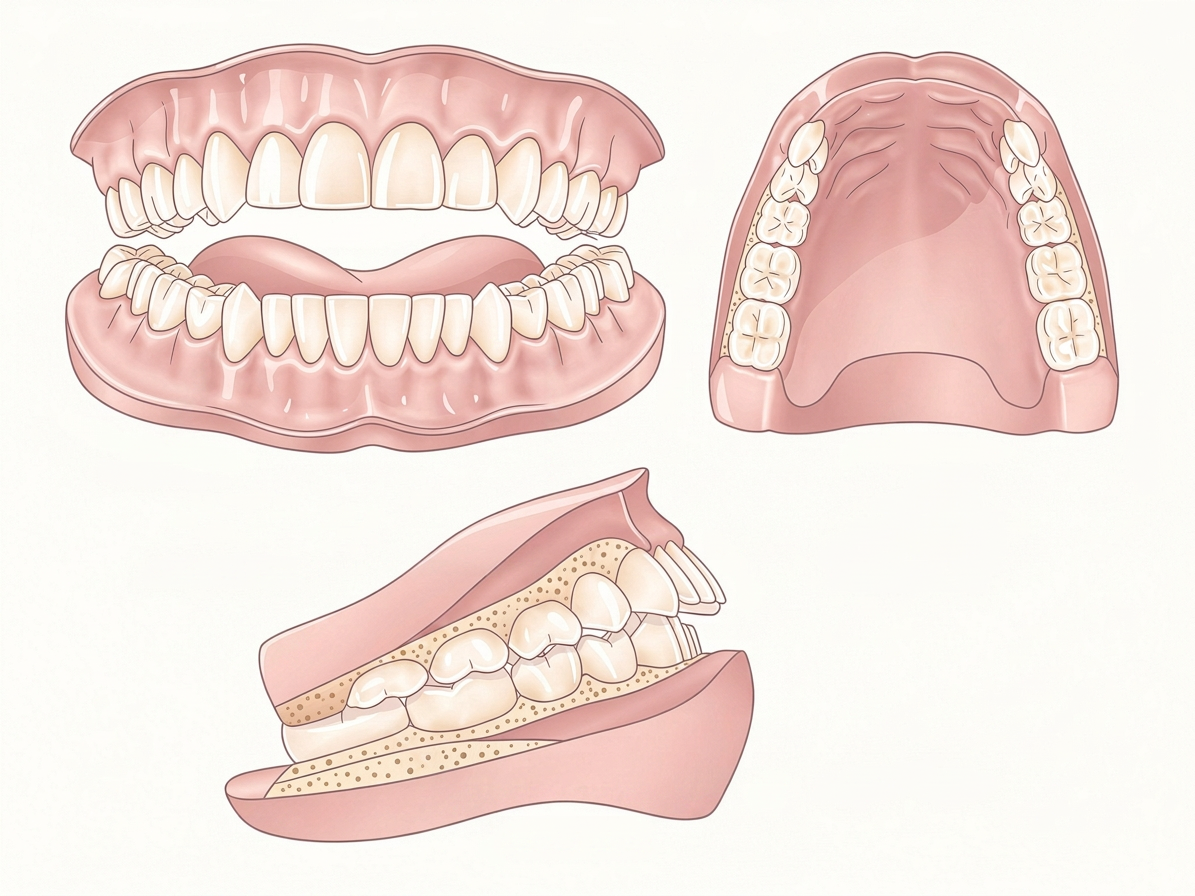
A patient comes in with a burning tongue, sore gums under a denture that "fits fine," or a mouth that just never feels quite right since the new plate went in. The denture looks perfect. The bite is even. Nothing on the outside explains what she's feeling. The answer, more often than most practitioners realise, isn't in the fit at all, it's in the toxicity of the material itself.
Not Every Molecule Finishes the Job
Denture bases are made from acrylic resin — poly(methyl methacrylate), or PMMA — built by polymerising a liquid monomer into a solid plastic. In a perfect world, every monomer molecule would link up into the polymer chain and none would be left over. In the real world, that conversion is never complete. A percentage of unreacted monomer always remains trapped in the material, and that residual monomer doesn't stay put.
A denture isn't chemically inert just because it looks solid. It continues to release unreacted monomer into the mouth for days after it's fitted — and for a meaningful minority of patients, that release is the actual source of their symptoms.
Where the Monomer Goes
Residual monomer leaches out of the denture base into saliva and the surrounding oral tissue, and the clinical picture that follows is well documented in the dental literature: cheilitis, stomatitis, tingling or numbness in the mouth, burning sensations of varying intensity, and in some cases oral candidiasis. In more pronounced allergic responses, this can progress to erythema multiforme, and contact stomatitis from acrylic appliances has also been reported in children wearing orthodontic devices. None of this requires a dramatic allergy — plenty of it is straightforward tissue irritation from ongoing chemical exposure.
Toxicity, Not Just Allergy
It's tempting to file all of this under "allergic reaction," but the research points to something more specific and, in some ways, more concerning: direct cytotoxicity. Residual monomer has been shown to have a dose-dependent toxic effect on fibroblasts and epithelial cells — the ordinary building-block cells of oral tissue — independent of any immune or allergic response. In one study, denture acrylic samples were implanted directly into animal tissue to observe the effect at the source: cold-polymerized acrylic, which retains more residual monomer than heat-polymerized material, produced a visibly more intense inflammatory response in the surrounding tissue than the heat-cured version. This is a material science problem playing out in living tissue, not a psychosomatic complaint.
Worth separating out clearly: the true allergen in many "denture allergy" cases isn't always the acrylic polymer itself. In several documented cases, the actual sensitising agent was the leftover benzoyl peroxide initiator or hydroquinone inhibitor used in the curing process, rather than the monomer. Both pathways matter clinically, but they're not identical, and patch testing is the only reliable way to distinguish a true allergic sensitivity from straightforward cytotoxic irritation.
Why This Happens More With Some Dentures Than Others
Not all acrylic is equal. Self-cured (cold-polymerized) resins consistently leach more residual monomer than heat-cured resins, because the curing process itself is less complete. Monomer release is also front-loaded: it continues leaching for roughly the first week after curing, with concentrations dropping markedly after the first one to two days. That's why the dental literature recommends terminal boiling during polymerization for at least thirty minutes, followed by storing heat-cured denture bases in water for one to two days before delivery to the patient — a simple manufacturing step that meaningfully reduces the monomer load a patient is actually exposed to.
Clinical Takeaways
- No acrylic denture is monomer-free. Complete polymerization doesn't happen in practice, and some residual MMA is always present in the finished appliance.
- The clinical picture is broad, from mild burning and tingling to stomatitis, candidiasis, and in rare cases severe reactions like erythema multiforme — often misattributed to fit, hygiene, or unrelated causes.
- This is a toxicity issue as much as an allergy issue. Residual monomer has a direct, dose-dependent cytotoxic effect on oral tissue cells, separate from any immune-mediated allergic response.
- Cold-cured acrylic carries a higher burden than heat-cured acrylic, and monomer release is heaviest in the first week after the appliance is made.
- Patch testing distinguishes a true allergic sensitivity (often to curing agents like benzoyl peroxide, not the acrylic itself) from straightforward chemical irritation — and the distinction changes what you tell the patient and the lab.
This isn't entirely a separate story from the one we've written about taste and afferent input in denture patients — it's a second, distinct afferent pathway feeding into the same system. That piece is about gustatory input: a taste signal changing motor output the instant the tongue makes contact, through cranial nerve pathways dedicated to taste itself. This one starts as chemistry — ongoing cytotoxic exposure to oral tissue — but chemical irritation doesn't stay purely chemical for long. Damaged or irritated tissue activates nociceptors, and a nociceptor firing is every bit as much an afferent signal as a taste receptor firing. A denture leaching residual monomer isn't just corroding tissue quietly in the background; it's very likely generating its own steady afferent barrage into the nervous system, independent of whatever the patient consciously tastes in the moment. Two different receptor types, two different cranial and spinal pathways — but both are afferent input, and both are candidates for disrupting the same protective reflex machinery. Untangling which pathway is driving a given patient's symptoms is still the first step toward treating it correctly.
References
- Rashid, H., Sheikh, Z., & Vohra, F. (2015). Allergic effects of the residual monomer used in denture base acrylic resins. European Journal of Dentistry, 9(4), 614-619.
- Ivković, N., Božović, D., Ristić, S., Mirjanić, V., & Janković, O. (2013). The residual monomer in dental acrylic resin and its adverse effects. Contemporary Materials, IV(1), 84-91.
- Kostić, M., Stanojević, J., Tačić, A., Gligorijević, N., Nikolić, L., Nikolić, V., Igić, M., & Bradić Vasić, M. (2020). Determination of residual monomer content in dental acrylic polymers and effect after tissues implantation. Biotechnology & Biotechnological Equipment, 34(1), 254-263.