A patient lies down for a strength check. She checks out as weak all over, even struggles to lift her leg. Then she removes a denture and all her strength returns. A piece of denture acrylic touches the tip of her tongue — nothing swallowed, nothing worn, just contact. She tries the same lift again. She can't do it. The material is removed, she rests a moment, and the lift returns. Nothing about her joints, her muscles, or her effort has changed. The only thing that changed was what touched her tongue.
That's not a story. It's something we've filmed, and it raises a question most practitioners have never been trained to ask: what is taste actually doing to the rest of the body?
An 82 year old with a toxic denture.
Taste Is an Afferent Input, Not Just a Flavour
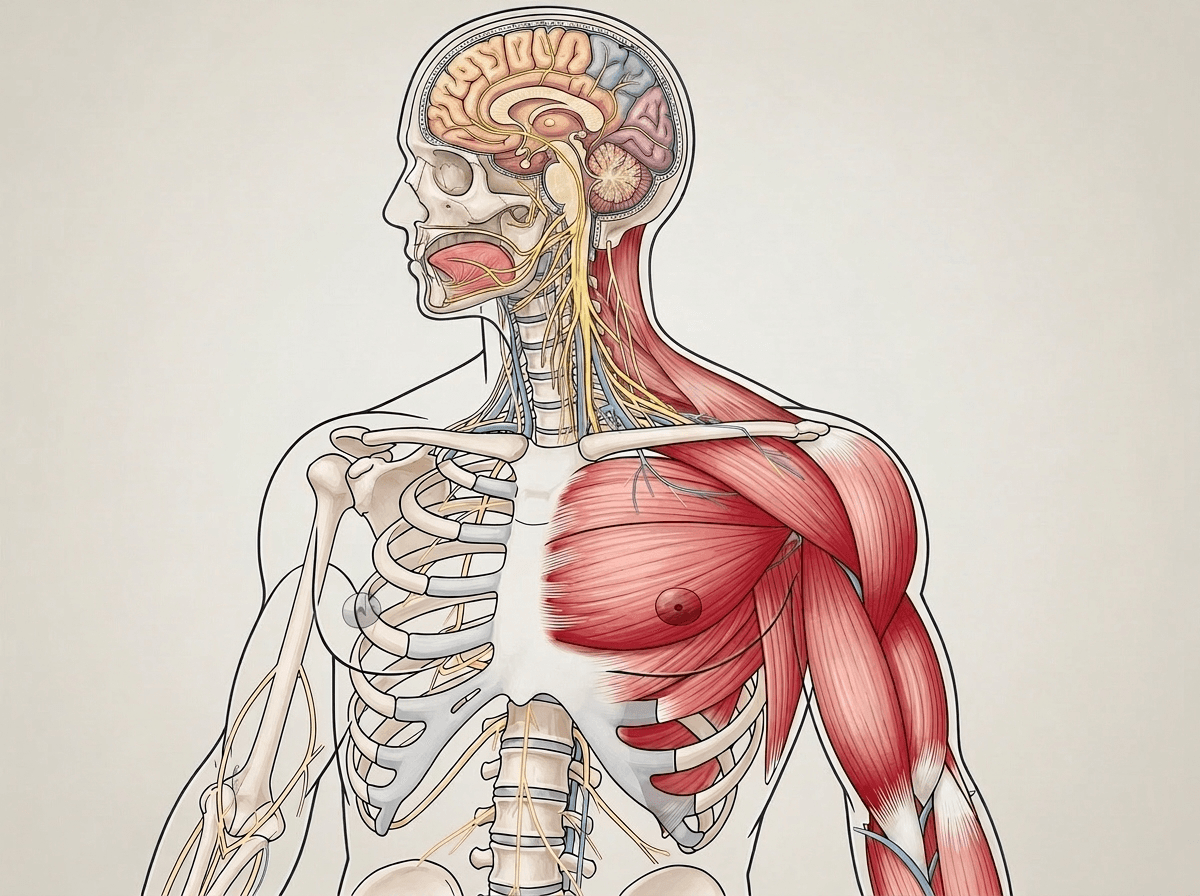
It's easy to think of taste as a purely sensory experience — pleasant, unpleasant, something you notice and move on from. But every taste sensation is, at its core, an afferent signal: a message travelling from receptors on the tongue, through cranial nerves, into the brainstem and beyond. The nervous system doesn't file that signal away as "just flavour." It processes it alongside every other input competing for the brain's attention — and some of what it does with that input reaches all the way down to motor neuron output.
Taste isn't something that happens to the tongue and stays there. It's a live neurological signal, and like every other afferent signal, it has the capacity to change what the rest of the nervous system does next.
What We're Showing — And What We're Not Claiming
Before going further, it's worth being precise about what these videos do and don't demonstrate. They are not manual muscle tests — there's no practitioner applying resistance and reporting a subjective impression of strength, a method with a long and well-documented history of unreliability when substances are involved. Both patients lift an actual weight, unassisted, and either complete the lift or they don't. That's an objective outcome, not an examiner's felt impression.
These are also not vial or held-substance tests. Vial testing — holding a sealed container of a supposed allergen or toxin — involves no genuine sensory contact at all, and multiple blinded trials have shown it performs no better than chance. There's no afferent pathway being engaged in that model, which is precisely why it doesn't belong inside a framework built on afferent input. What's shown here is different: direct tongue contact with a real material, a real taste, and a real, measurable performance outcome.
What we are not claiming is a fully controlled, blinded, mechanistic proof. These are clinical observations from two patients, not a research trial. Neither patient was blinded to what was touching their tongue, which means we can't fully rule out expectation playing some role in the result. What we can say is that the change was immediate, repeatable within the same session, and reversed when the stimulus was removed — which is exactly the kind of observation that's worth investigating further, not the kind that proves a mechanism on its own.
The Research That Makes This Plausible
Independent of these two cases, there's a genuine, peer-reviewed body of research showing that oral taste stimuli can alter physical performance without any nutrient ever being absorbed. In sports science, this is well known as the "mouth rinse" effect: rinsing the mouth with a carbohydrate solution — and spitting it out, never swallowing — measurably improves exercise performance, even though no calories are absorbed and blood glucose doesn't change. The effect disappears if the same carbohydrate is delivered directly into the bloodstream instead, bypassing the mouth entirely. The mouth itself is doing something the stomach can't replicate.
Brain imaging studies have shown why. When carbohydrate is detected in the mouth, it activates regions of the brain involved in reward and, critically, motor control — including circuitry that increases corticomotor excitability. Later studies extended this beyond endurance exercise into strength and resistance training specifically, finding that combined taste stimuli could alter measures of muscular strength and endurance, with the proposed mechanism being improved neural drive to the motor units themselves.
None of this research used denture acrylic, and none of it involved the immediate strength swings shown in these videos. But it establishes something important as a matter of settled science: taste on the tongue is a real afferent pathway with a demonstrated capacity to alter motor output, through mechanisms that have nothing to do with nutrition or metabolism. That's the principle these two cases appear to be showing in a much more dramatic, immediate form.
Why This Matters Clinically
If taste genuinely can suppress motor output this directly, it reframes a question worth asking every patient wearing an oral appliance — dentures, retainers, mouthguards, orthodontic devices — who presents with unexplained weakness, fatigue, or a strength deficit that doesn't resolve with conventional treatment. The appliance itself may be a source of ongoing afferent disruption, distinct from — and in addition to — any chemical irritation from the material leaching into the tissue (a separate, well-documented issue in its own right; residual monomer from acrylic denture bases is independently associated with tissue irritation and cytotoxicity). Taste and chemical exposure may both be happening at once, but they are not the same mechanism, and a patient's presentation may point more toward one than the other.
Clinical Takeaways
- Taste is a genuine afferent input, not merely a subjective sensory experience — and afferent inputs are capable of altering motor neuron output.
- This is distinct from Applied Kinesiology's discredited testing methods. There is no vial, no held substance, and no subjective manual resistance test — only real sensory contact and an objective, patient-performed lift.
- These are observations, not proof of mechanism. Two clinical cases demonstrate a striking, repeatable, reversible pattern — they don't establish a fully controlled result, and further investigation with blinding would be needed to rule out expectation effects entirely.
- The broader principle is independently well-supported. Peer-reviewed research on oral carbohydrate and caffeine "mouth rinsing" confirms that taste stimuli can alter strength and endurance performance through direct effects on motor control circuitry, with no nutrient absorption required.
- For patients with oral appliances and unexplained weakness, the taste of the material itself — separate from any chemical irritation — is worth considering as a contributing afferent input.
What a patient tastes may be doing far more than flavouring their day. If two seconds of contact with the tongue can take a strong lift away and give it back again, it's worth asking what else in a patient's mouth might be quietly doing the same thing, unnoticed, every day.