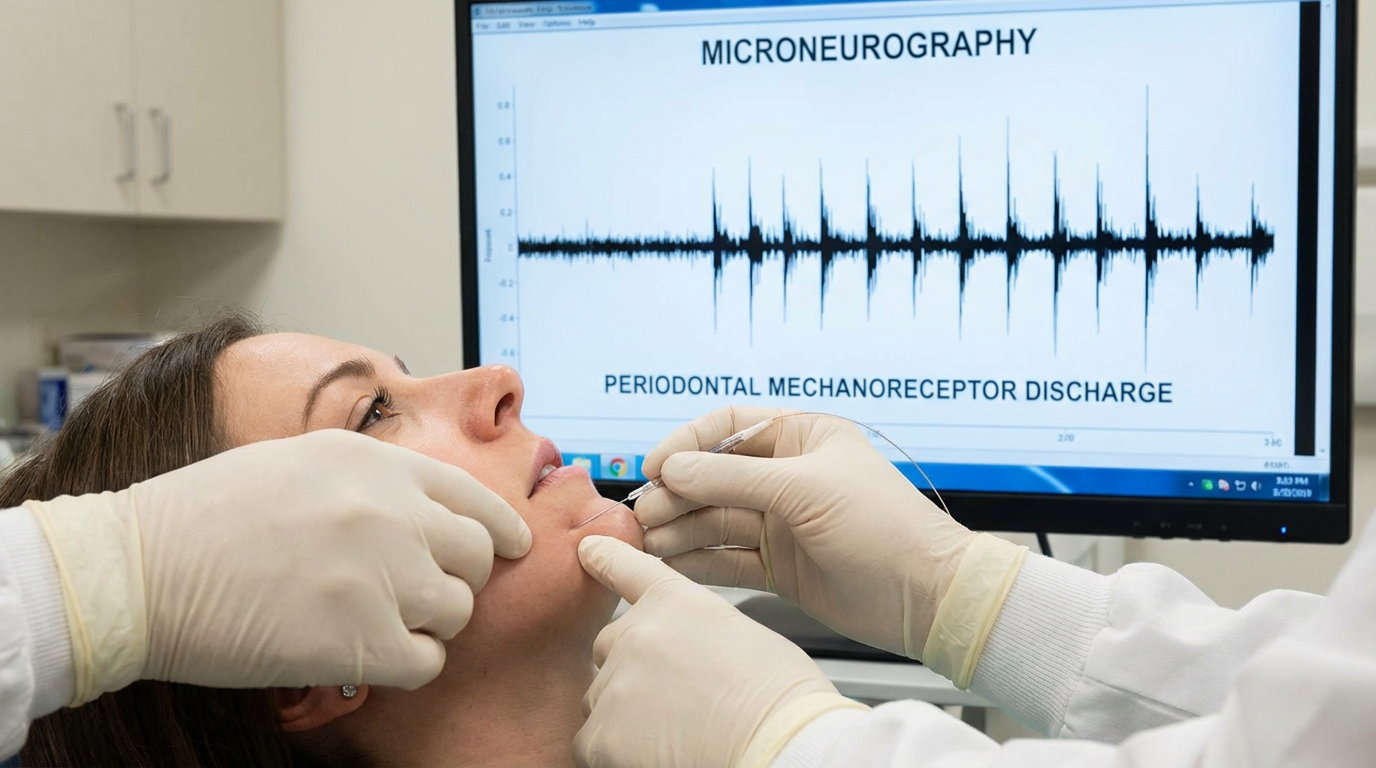
In the world of clinical neuroscience, few techniques are as revered—or as difficult—as microneurography. By inserting microelectrodes directly into the inferior alveolar nerve of awake human subjects, Professor Mats Trulsson achieved the neurological equivalent of "wiretapping" the mouth. His work transitioned our understanding of the periodontal ligament from a mere shock absorber (hardware) to a sophisticated sensory organ (software).
The Baseline for the Neurological Voltmeter
Trulsson’s findings fundamentally changed the "Nail in the Foot" analogy from a concept to a clinical reality. He discovered that periodontal mechanoreceptors (PMRs) are not passive. Instead, they exhibit spontaneous discharge even in the absence of external stimuli.
This baseline activity allows for a hyperbolic force-encoding relationship. The receptors are most sensitive at the extreme low end of the spectrum—specifically forces below 1 N. Because the ligament sensors are already supplying an input, the brain can detect the infinitesimal change of a hair or a grain of sand instantly. Once force increases beyond this threshold, the firing rate saturates, shifting the brain's priority from detection to protection.
"Spontaneous input provides the brain's 'Ready State.' It ensures the withdrawal reflex is primed to fire before the 'hardware' of the tooth is compromised by unexpected loads."
Directional Tuning and Task-Specific Loops
Trulsson’s research proved that each tooth does not act in isolation. Through Spatial Vectoring, individual afferents are tuned to specific directions (e.g., lingual vs. labial). The brain aggregates this data to determine the exact trajectory of food movement.
Furthermore, Trulsson identified Mechanical Coupling across the dental arch. Nearly half of the recorded afferents responded to loads on adjacent teeth. This creates a Task-Specific Loop where the brain tracks a food bolus across the "keyboard" of the teeth, adjusting muscular force in real-time based on the shifting sensory input.
Clinical Takeaways: Hardware vs. Software in Oral Rehabilitation
This research provides the scientific bedrock for the Afferentology approach, particularly when addressing the limitations of dental implants and chronic clenching:
- The 20% Feedback Rule: PMR feedback accounts for roughly 20% of the EMG activity during jaw closure. Without this "software" input, the brain loses its "brake," leading to the excessive force and "clunky" motor patterns seen in implant patients.
- Sensory Saturation: Because PMRs are slowly adapting, they provide continuous data. When this data is corrupted—or missing—the brain enters a state of sensory hunger, which Trulsson’s more recent work links to accelerated cognitive decline.
- Withdrawal Reflex Dominance: If the 50Hz tone is disrupted by a "Nail in the Foot" (e.g., high dental restoration or scar tissue), the brain defaults to a protective inhibited state, weakening the primary muscles of mastication.
Research Foundations & References
- Trulsson, M., & Johansson, R. S. (1996). "Encoding of tooth loads by human periodontal afferents and their role in jaw motor control." Progress in Brain Research.
- Trulsson, M. (2006). "Force encoding by human periodontal mechanoreceptors during mastication." Archives of Oral Biology.
- Trulsson, M., & Gunne, H. S. J. (1998). "Food-holding and -biting behavior in human subjects with implant-supported fixed prostheses." Journal of Dental Research.
- Johnsen, S. E., & Trulsson, M. (2003). "Receptor activation by tactile stimuli applied to spinal-linked teeth." Journal of Neurophysiology.
- Grigoriadis, A., & Trulsson, M. (2019). "Effect of Sudden Deprivation of Sensory Inputs From Periodontium on Mastication." Frontiers in Neuroscience.