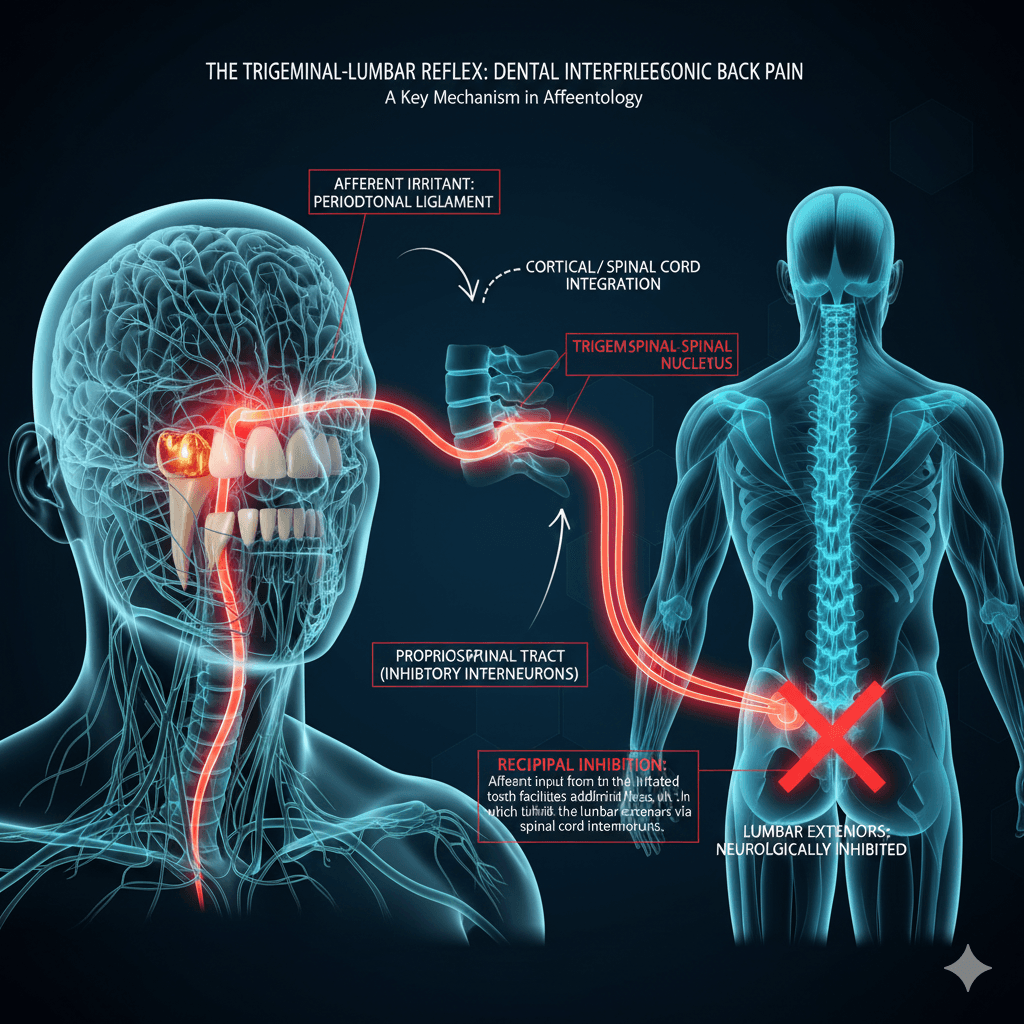
For this patient, excessive afferent input (nervous signals to the brain) coming from his periodontal ligaments (in his mouth) caused back pain and weakness in his lower back.
This case demonstrates how quickly muscle tone can change when the source of aberrant afferent input is identified and addressed.
We often talk about muscle tone as if it were a matter of physical fitness or "hardware" density. In reality, muscle tone is a purely neurologic phenomenon. It is the result of a constant, invisible conversation between your peripheral sensors and your spinal cord—a conversation that must remain free of interference for you to move without pain.
The basic unit of this function is the neurological impulse. While most sensors wait for a stimulus, two tissues are unique: the muscle spindle cells and the periodontal ligaments in your mouth. These tissues spontaneously generate "afferent" input—electrical signals that travel to the central nervous system.
At least 90% of our muscular activity happens beneath our conscious awareness, governed by reflexes. The muscle spindle afferents are the primary drivers of the myotatic reflex and body position sense. They don't just tell the brain where the arm is; they mediate the actual "software" output of your motor neurons via the propriospinal tracts.
The Mouth-Body Connection: A Clinical Breakthrough
If you want to change muscle tone instantly, you don't look at the muscle; you change the afferent input. One of the most potent sources of this input is the mouth. Because the periodontal ligaments are so sensitive, a "faulty" dental crown can act like a constant source of corrupted data, inhibiting major muscle groups elsewhere in the body.
Case Study: The "Slipped Disc" Sign
You’ve seen it before: a patient with a suspected "slipped disc" who cannot stand up straight without "walking" their hands up their thighs. We’ve been taught this is a hardware failure of the disc. In many cases, it is actually a failure of the gluteal muscles and lumbar extensors due to neurological inhibition.
In the video (above), you can see this patient struggling with classic acute lumbar instability. Watch the dramatic shift when we change the afferent input simply by having him bite on a specific gold crown. The "software" reset allowed his lumbar extensors to fire at their natural 50hz resting tone, enabling him to stand and bend with zero pain. The eventual removal of the offending crown led to a full, permanent recovery.
The Common Denominator of Healing
Afferent input is the secret language of every therapy. It explains why a treatment works one day and fails the next—the "hidden reasons" usually lie in a corrupted loop the practitioner hasn't yet identified. Whether it is a dental crown or a surgical scar, these "nails in the foot" must be removed before the body can heal.
Understanding this loop makes the goal of getting patients better faster and more easily a clinical reality. It’s not magic; it’s just better data.