by Simon King B.App.Sc.(Chiro) DIBAK
You adjust the same segment week after week. It holds for a few days, then it's back.
What if the problem was never in the spine?
What Does Subluxation Actually Mean?
Every chiropractor knows the trouble with the word subluxation. Outside the profession it means "a bone out of place", which feeds the "my back is out" myth. Inside the profession it means something else: interference with the nervous system.
That hidden meaning has cost a lot of goodwill. The idea isn't the problem. The problem is that the profession has never been able to reliably demonstrate the lesion, define where it comes from, or show it can be removed efficiently and cost-effectively.
The Association of Chiropractic Colleges defines a subluxation as "a complex of functional and/or structural and/or pathological articular changes that compromise neural integrity and may influence organ system function and general health."1
So here's the question nobody seems to ask.
What does "compromised neural integrity" actually look like? And how would you measure it?
Neural Integrity at the Anterior Motor Neuron
A nerve impulse is all-or-nothing. Its amplitude is fixed. That leaves the nervous system only two ways to change a signal: how fast a neuron fires, and how many fibres are recruited.
Set aside paralysis for a minute, and "compromised neural integrity" can only mean one of two things. Inhibition or facilitation. Too little drive or too much, on the afferent side, the efferent side, or both.
Look at it at the anterior motor neuron. Each one receives 10,000 or more inputs. Some push it towards firing, some push it away. When the sum takes it past threshold, it fires and the muscle contracts. More facilitatory input and it fires faster. More inhibitory input and it slows, within a range of roughly 5 to 50Hz.
And every facilitated muscle needs its antagonist inhibited. That's reciprocal inhibition. It's what allows smooth movement without the joint being pulled apart.
That is what neural integrity means in neurological terms. Not philosophy. Summation at the motor neuron.
Muscle Inhibition Comes Before Injury
Muscle inhibition is already recognised in back and joint pain. But it's hard to measure, so most research assumes the injury came first and the inhibition followed. MacDonald, Moseley and Hodges found back muscle dysfunction persisting in patients even while their recurrent back pain was in remission.2
I'd go further. In many cases the inhibition was there first. It's what allowed the injury.
Inhibition is painless. We move in and out of it all day without noticing. The tissue damage it allows - now that is painful.
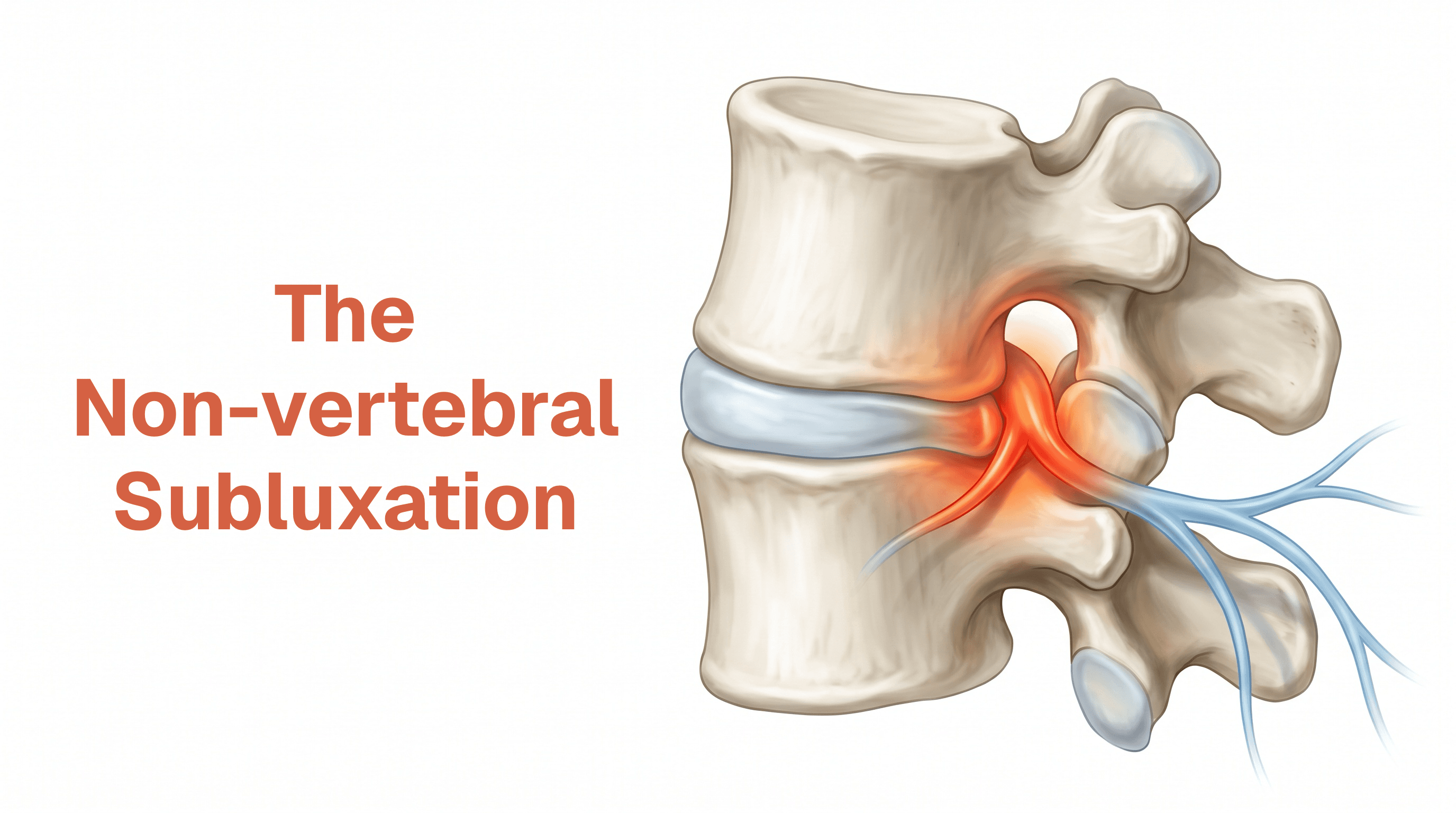
The Withdrawal Reflex: A Non-Vertebral Subluxation
Every physiology textbook has the same diagram of the flexor withdrawal reflex. A tack. A foot. Flexors facilitated, extensors inhibited, foot lifted.
It's a useful picture, but it misleads in three ways.
The input doesn't need to be a tack. A feather, a pebble, hot sand or a bee sting will all do it.
It isn't confined to the feet. Tickle a child and watch what happens to their muscle tone. The whole body is wired this way.
And it isn't only flexion. Skin irritation can drive abduction, adduction, rotation and extension. The withdrawal reflex connects your entire muscle system to your skin.
So the tack in the foot compromises neural integrity. By the profession's own definition, it is a subluxation. It just isn't vertebral.
The fix is obvious. Pull the tack out and neural activity returns to normal.
But what if the tack stayed in for 20 or 30 years?
Nail in the Foot: Earrings, Piercings and Dental Work
That's not as far-fetched as it sounds.
We will always take a nail out of our foot. But we'll leave one in our ear for decades.
An earring is a nail through the skin. Whether it causes a problem is largely luck. It depends on whether it stimulates skin receptors, and skin mechanoreceptors are so sensitive they can feel one hair move.
When it does, the body tries to withdraw from it. In clinic I often find the neck muscles inhibited on the same side as the earring and facilitated on the opposite side. Put an earring in both ears and you have persistent abnormal afferent input pulling the neck two ways at once, with knock-on effects down the spine.
The wearer feels nothing.
Imagine that patient. Earrings for fifteen years, no symptoms. Then a minor rear-end shunt at a junction. The neck muscles can't stabilise the joints in time, and an injury that should have settled in weeks drags on for years. Or there's no accident at all, just slow degeneration, because muscles that can't produce full range of motion leave the joints unstable through every ordinary day.
A navel piercing tends to do something similar to the trunk: abdominals facilitated, back extensors inhibited. You could adjust the resulting fixations for years and never touch the cause.
Then there's the mouth. Look at the sensory homunculus. The mouth takes up a huge share of the sensory cortex, and much of that input exists to control muscle output. Dental work that contacts the gums and mucous membranes can have a profound effect on muscle tone. It's a prime suspect when a vertebral correction simply won't hold.
These are the obvious ones. I've identified at least a dozen other sources of hidden afferent irritation.
The Withdrawal Reflex and Acupuncture
Insert a needle and you trigger the withdrawal reflex. Muscles are facilitated and inhibited, with effects on joints, blood supply and organs.
That may be why trials comparing acupuncture with sham acupuncture (skin stimulation without penetration) find no difference between them,3,4 and why it seems to be needling an area, rather than the precise point, that matters most.5
The skin is the input. The point is incidental.
Where Afferentology Fits for Chiropractors
Now the part that matters for you.
Afferentology isn't a new chiropractic technique. It's a separate paradigm: the study of afferent input and how it controls muscle and nervous system function. But it answers the question chiropractic has been asking for over a century. What is the interference, and where does it come from?
Nobody specialises in this. Medicine has largely ignored it. The usual answer to a weak muscle is exercise.
Exercising an inhibited muscle is like changing the oil every day when you have a flat tyre.
An inhibited muscle can't respond to training until its neural drive is restored.
That leaves an open space, and chiropractors are well placed to fill it. You already think in terms of the nervous system. You already have patients who come back with the same subluxation week after week.
Afferentology gives you a way to find the inhibition with Protective Reflex Testing (PRT), trace it to its source, and remove the cause instead of chasing the effect.
What do you get from that? Patients who hold their correction instead of relapsing. An explanation you can give in plain neurological terms, without the baggage the word subluxation carries. And a mechanism you can defend to anyone, because it stands on Sherrington, not on philosophy.
You don't have to abandon your roots to do this. You just have to look beyond the spine for the subluxations you can't adjust.
If you'd like to see how it works in a real treatment room, that's what we teach on the Clinical Residency.
To your strength!
Simon