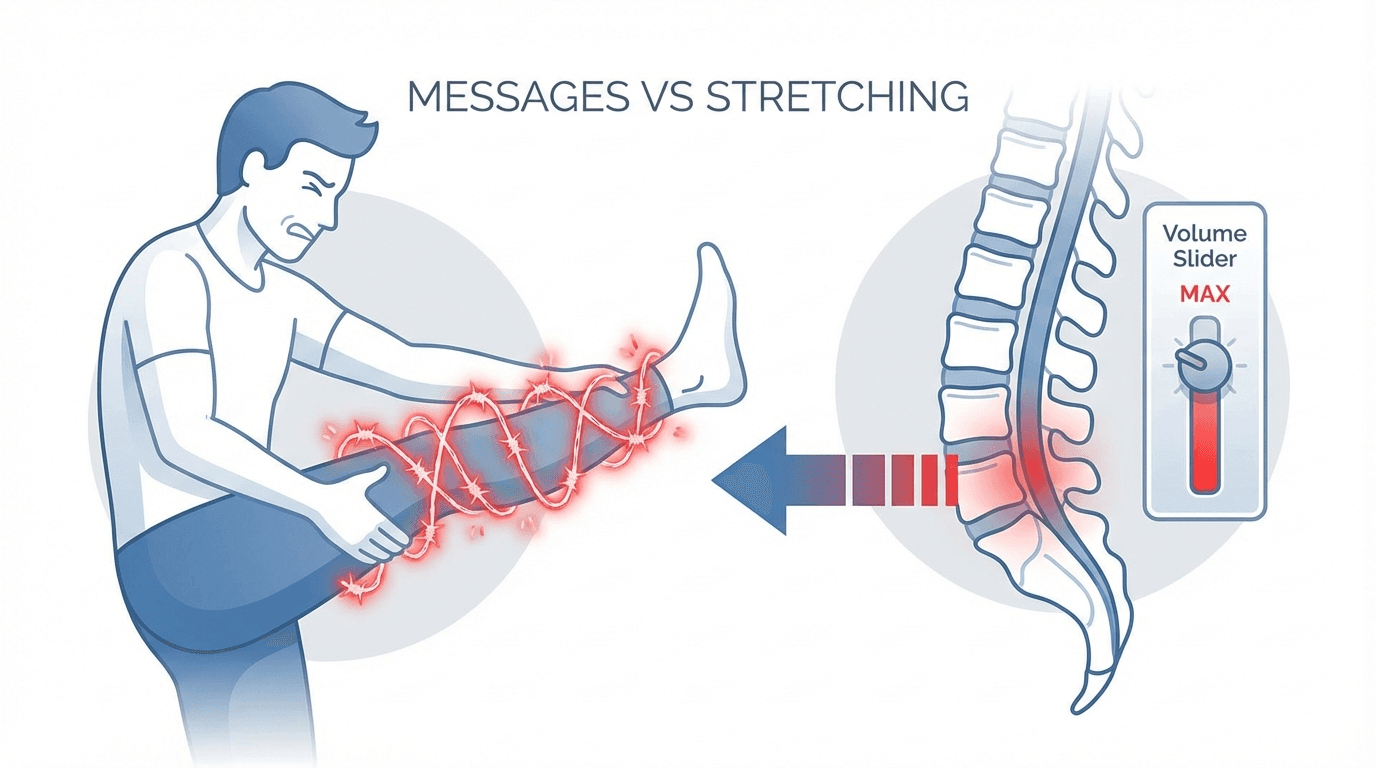
Imagine that sometimes, your muscles are broadcasting a "distorted reality" to your brain, where every movement feels like a threat even when the "hardware" is perfectly intact. Understanding why your sensors are sending corrupted data is the first step in moving from temporary relief to a permanent neurological reset.
In our Clinical Residency, we often describe the body as a high-fidelity information system. A groundbreaking biophysical model published in eLife has finally confirmed the mechanics behind the "Software" we’ve been testing for years. It turns out that muscle spindles—the primary Afferent sensors—don’t just measure how long a muscle is; they measure the "Internal Yank" of the system.
Beyond the Hardware: The Mechanistic Source of Afferent Input
Traditional anatomy teaches that muscle spindles are simple length sensors. However, this new research proves that spindle firing arises from complex cross-bridge mechanics inside the sensor itself. The signal sent to the brain is actually a combination of "Force" and "Yank" (the time-derivative of force).
This means your proprioception isn't just a measurement of where your arm is in space—it’s a measurement of the tension and "jerk" within the tissue. In Afferentology, we recognize that if these internal mechanics are disrupted (by a scar or old injury), the spindle starts broadcasting "static." This corrupted data is what the brain uses to decide whether to keep the power on or flip the kill switch.
The 50Hz Tone and the Gamma Dial
The study highlights the role of Gamma motor neurons, which act as the "volume knob" for these sensors. Static gamma drive raises the baseline firing rate—essentially setting the 50Hz resting tone of the muscle.
"You cannot foam roll a high-frequency signal out of a spindle. If the Gamma drive is dialed to 'Threat,' the muscle will remain in a state of protective tension regardless of how much 'Hardware' work you do."
When the brain perceives a threat—the classic Nail in the Foot analogy—it uses the Gamma system to pre-tension the spindles. This creates a hyper-vigilant sensor that triggers a Withdrawal Reflex at the slightest movement, leading to that "permanently tight" feeling that clinicians see every day.
The Alpha-Gamma Interaction: Solving the Paradox
One of the most profound findings of this paper is the "Paradoxical Spindle Response." During a muscle contraction, a spindle should go slack and stop firing. Yet, the model shows that because of the interaction between Alpha (muscle) and Gamma (spindle) drive, the sensor can actually increase its firing during contraction.
This is the mechanical proof of why a muscle can be "weak" on a Precision Muscle Test even if it looks large and healthy. If the Alpha-Gamma coordination is de-synced, the brain receives a "threat" signal even as it tries to contract the muscle, causing an immediate neurological inhibit.
Clearing the Static: The Software Reboot
The paper demonstrates that spindle output can resemble length, velocity, or acceleration depending on the motor command. This confirms why Task-Specific Loops are so critical. A sensor might behave perfectly during a slow stretch but broadcast "Total System Failure" during a rapid load.
By identifying the specific Afferent Irritant (the corrupted force/yank signal), we can convince the brain to dial back the Gamma drive. Once the "static" is cleared, the 50Hz resting tone normalizes, and the "Software" allows the "Hardware" to move effortlessly again.
Clinical Takeaways for the Practitioner
- Spindles are Force Sensors: They respond to "Yank" (rate of force change), not just length. This is why sudden movements often trigger chronic protective patterns.
- The Gamma Volume Knob: Chronic tightness is often a high Gamma-drive setting, not a "short" muscle. You must reset the signal to change the tone.
- History Matters: Spindle firing is "history-dependent." Previous movements and injuries change the current "Software" state of the muscle.
- The Software Reboot: Protective Reflex Testing allows us to find where the "Internal Yank" is being misinterpreted as a threat, allowing for an instantaneous reset of the Withdrawal Reflex.