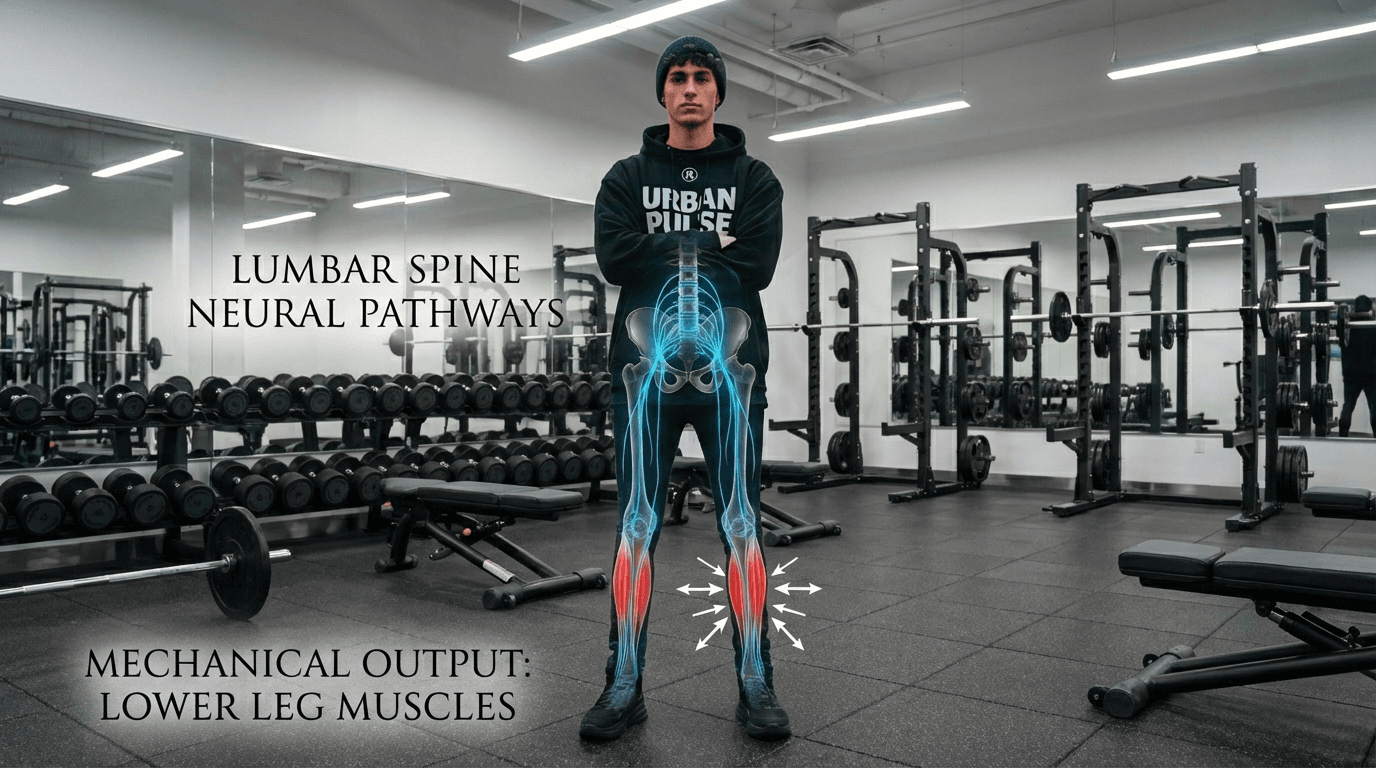
The Neurological Voltmeter: Proving the Causal Link Between Mind and Motion
You’ve spent years focusing on the "hardware" of the human body—the bones, tendons, and muscle fibres—only to find that chronic instability persists. What if the missing link isn't a lack of strength, but a corruption in the signal that tells those muscles to fire?
Recent groundbreaking research in In Vivo Neuromechanics (published in Scientific Reports) has finally provided the mathematical "smoking gun" for what we practice in Afferentology: your movement is not a mechanical byproduct; it is a direct, causal output of the spinal software.
The Neural Driver: Proving That Software Rules the Hardware
For decades, traditional biomechanics viewed the body as a series of pulleys. This study flips that script by decoding hundreds of individual α-motor neuron discharges in real-time. By integrating these neural "sparks" into subject-specific models, researchers were able to predict ankle joint moments with over 90% accuracy.
This proves a causal link between the neural drive and mechanical output. In Afferentology terms, the muscle is "dumb" tissue—it is merely a readout of the electrical command coming from the spinal cord. If the joint fails to stabilise, it isn't because the "cable" is broken; it’s because the "operator" has turned down the voltage.
The 50Hz Tone: Decoding the High-Fidelity Signal
In our Clinical Residency, we often discuss the 50Hz resting tone—the baseline frequency that keeps a muscle "plugged in" and ready for action. The study utilised high-density EMG to deconstruct this signal across seven lower-limb muscles, revealing a high-fidelity map of the net neural drive.
"You cannot fix a mechanical failure with a mechanical solution if the cause is a software glitch. To restore power, you must restore the integrity of the signal."
When this neural drive is crisp and clear, the "hardware" performs flawlessly. However, when the brain perceives a threat—an old surgical scar, a dental irritant, or a "Nail in the Foot"—it introduces "static" into the loop. This static doesn't just make you feel tired; it physically alters the motor neuron discharge, lowering the voltage of the Neurological Voltmeter.
Task-Specific Loops and the Withdrawal Reflex
The researchers noted that this neural-mechanical link is highly specific. In Afferentology, we call these Task-Specific Loops. The study’s open-loop framework showed that the motor neurons are the primary commanders of the joint's fate.
If an Afferent irritant triggers a Withdrawal Reflex, the brain will selectively inhibit specific motor neurons to protect the system. This explains why a patient might have a "passing" score on a handgrip test but "fail" a trunk stability test—the brain has surgically reduced the voltage in one specific task-loop to avoid further injury.
Protective Reflex Testing: The New Diagnostic Frontier
The study concludes that this "neural data-driven paradigm" opens doors for personalised neurorehabilitation. For the Afferentology practitioner, this is the scientific validation of Protective Reflex Testing. We are not just checking if a muscle is "strong"; we are probing the causal link between the spinal cord and the joint.
By clearing the "corrupted data" from the afferent system, we aren't just stretching a muscle—we are updating the software to allow the motor neurons to fire at full capacity again.
Clinical Takeaways
- The Causal Link: Joint stability is a direct result of motor neuron discharge behaviour, not just muscle mass.
- Software over Hardware: If a joint moment is failing, investigate the "Software" (neural drive) before assuming a "Hardware" (tissue) failure.
- Task-Specificity: Neurological inhibition is often targeted. Test the specific loop (e.g., trunk stability) rather than relying on general metrics like handgrip.
- The Voltmeter: Use muscle testing as a real-time readout of the CNS’s perceived safety. If the power is low, find the Nail in the Foot causing the withdrawal.
Ready to master the software? Learn more about our Clinical Residency and how to identify these task-specific loops in our latest deep dive.