The 50Hz Tone: Beyond the Handgrip
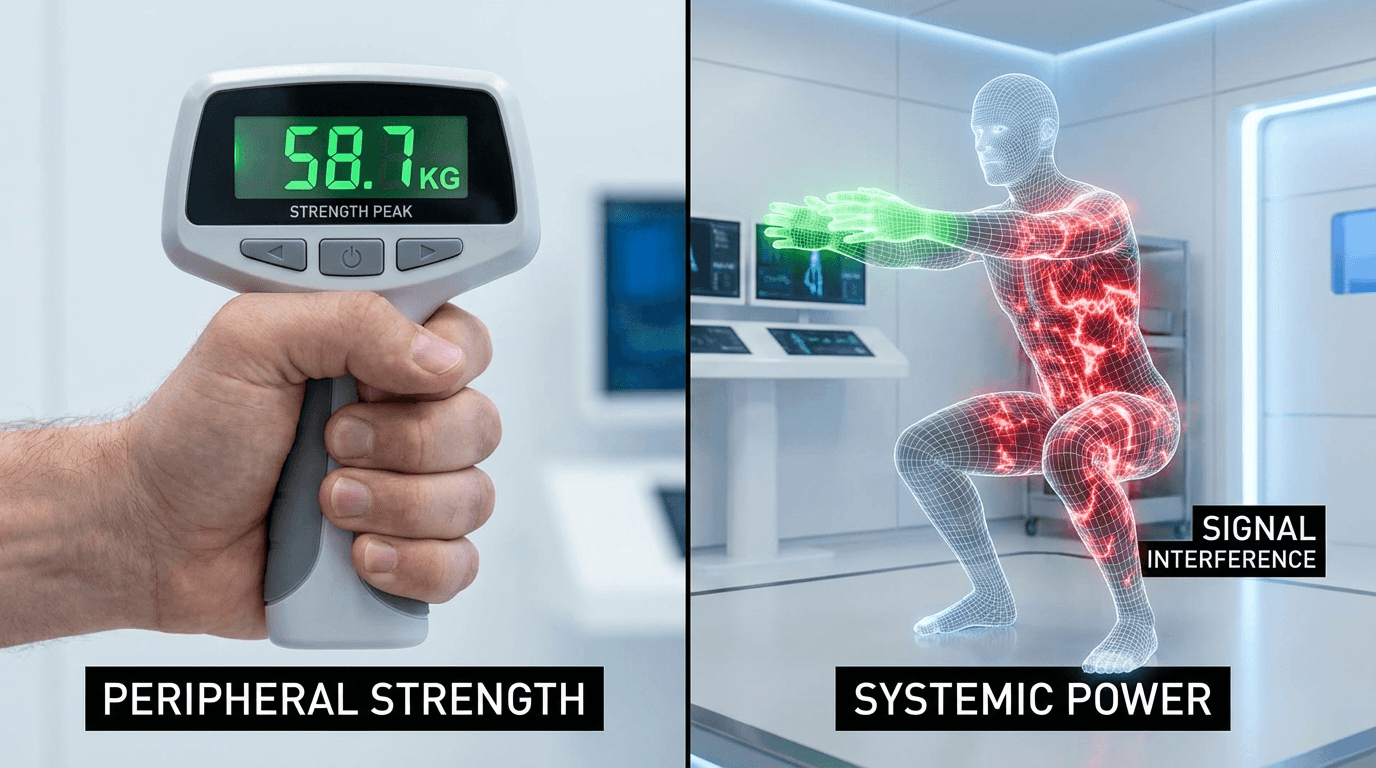
While traditional screenings often rely on handgrip strength as a convenient proxy, it is merely a window into a much larger system. As an Afferentologist, you understand that whole-body power—the ability of the entire system to recruit motor units rapidly—is the true "Neurological Voltmeter."
Recent data suggests that while handgrip strength correlates with longevity, total muscle power is a significantly more accurate predictor of morbidity and mortality. This is because power requires more than just muscle mass (the hardware); it requires a high-velocity 50Hz resting tone and seamless coordination from the central nervous system (the software). When the brain feels safe, it allows the "voltage" to stay high across the entire chain.
The Withdrawal Reflex: A System-Wide Shutdown
The reason whole-body power is a superior predictor of survival is found in the specific nature of the Withdrawal Reflex. This reflex is not a general safety "dimmer switch"; it is a surgical, localized inhibitory response designed to protect specific structures likely to be damaged by muscle contraction. If an Afferent Irritant—your "Nail in the Foot"—is detected, the brain will inhibit the muscles in that kinetic chain to prevent localized trauma.
Because these reflexes are so targeted, an irritant in the hip, spine, or lower limb may inhibit your total-body power while leaving your handgrip strength relatively high. If we only measure the hand, we miss the systemic collapse happening elsewhere.
"A strong grip can mask a failing system. Because the Withdrawal Reflex only inhibits the 'at-risk' hardware, you can have a powerful squeeze while your core and legs are under a neurological 'kill switch.' Measuring whole-body power is the only way to ensure the entire circuit is open."
Because whole-body power is a more complex neurological task than a simple squeeze of the hand, it is the most sensitive indicator of corrupted data in the afferent system. It is also, crucially, the most responsive to treatment. When you remove the irritant—the scar tissue, the dental focal point, or the joint receptor error—the "software" update is instantaneous. The power returns not because the muscle grew, but because the brain restored the signal.
Precision Over Protocols
Standard exercise protocols fail because they try to "strengthen" inhibited muscles. Afferentology reverses this. By using Protective Reflex Testing to identify which parts of the whole-body power chain are being "turned off," we find the specific afferent input causing the shutdown. Fixing the signal doesn't just improve a test score; it restores the biological resilience that keeps patients alive.
Clinical Takeaways- Power Over Strength: Whole-body power is a more sensitive and accurate predictor of mortality than isolated grip strength.
- Software Responsiveness: Total body power is the most rapid indicator of a successful neurological "reset."
- The Kill Switch: Systemic weakness is often a protective Withdrawal Reflex triggered by hidden Afferent Irritants.