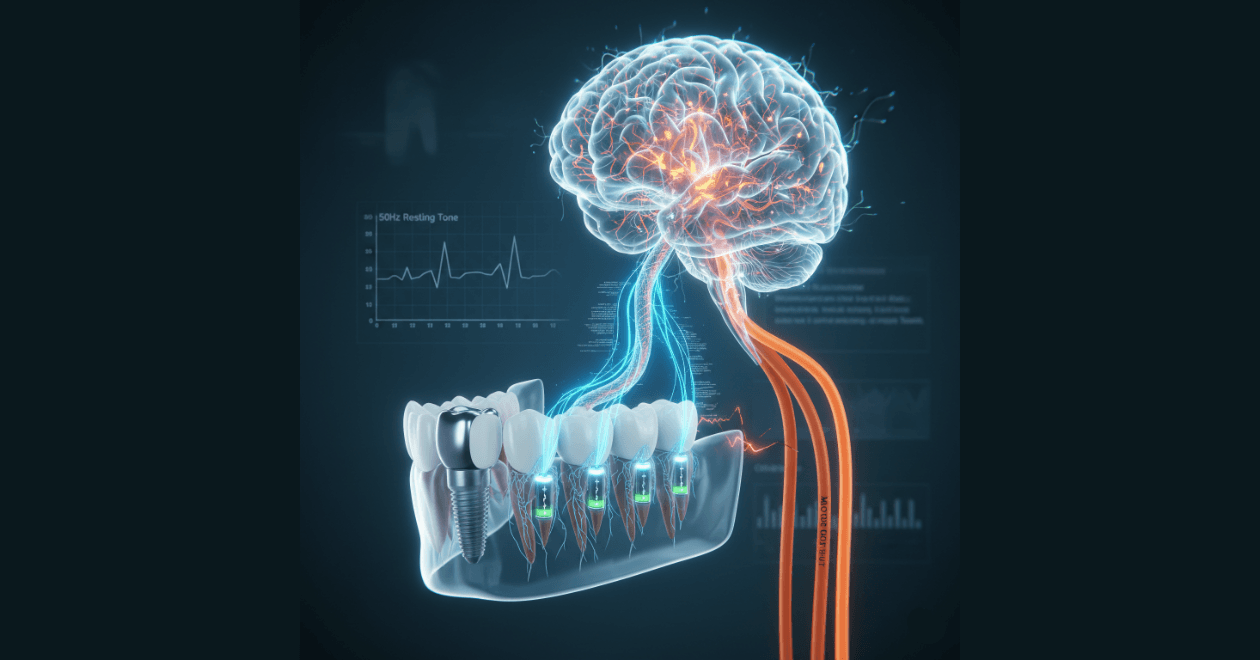
In the world of Afferentology, we often discuss the Neurological Voltmeter, but to truly understand systemic health, we must look at the source of the current. Professor Mats Trulsson’s microneurography research at the Karolinska Institutet reveals that our sensory receptors—specifically the periodontal mechanoreceptors (PMRs) and muscle spindles—function like billions of tiny biological batteries. These batteries don't just send data; they supply the vital "amperage" required to keep the brain and spinal cord fully charged.
Department of Dental Medicine, Karolinska Institutet
The 50Hz Charge: Maintaining the Baseline Amperage
Trulsson’s work identified the continuous electrical discharge from the periodontal ligament receptors, even when the teeth aren't touching. This input is what forms the baseline activation of the nervous system. In our Clinical Residency, we teach that without this adequate Afferent input, the central nervous system cannot sustain adequate output. If the batteries are low, the motor output will flicker, resulting in a measurable lack of strength, diminished health, and compromised longevity.
"Think of your periodontal ligaments and muscle spindles as the alternator of a car. If the alternator (afferent input) fails, the battery (the brain) eventually drains, and the engine (the body) stalls—no matter how 'perfect' the hardware looks."
The "Nail in the Foot" and Power Leaks
When we lose teeth or suffer from chronic muscle spindle dysfunction, we aren't just losing a "part"; we are cutting the power lines. Recent research shows that tooth loss is a primary driver of systemic decline. From an Afferentology perspective, this is a "power leak." A missing tooth or a corrupted signal acts like a Nail in the Foot, forcing the brain into a short-circuit state, leaving it weakened and vulnerable to external and internal stressors.
Hardware vs. Software: Why Implants Can't Charge the Brain
This is the fundamental flaw in modern "hardware-only" dentistry. A titanium implant is a magnificent piece of hardware, but it is an inert material. The implant is placed into bone where there are no spindles; no nerve endings; no residual afferent input. It cannot "charge" the brain. Trulsson’s research proves that implant patients use erratic muscle control because their "Neurological Voltmeter" is reading zero. To restore true health, we must find ways to recalibrate the remaining sensory "batteries" to compensate for the lost current.
Clinical Takeaways: Feeding the High-Voltage Brain
- Input Governs Output: You cannot fix a "weak" muscle or a "slow" brain if the afferent amperage is low. Strength is a neurological output of a well-charged system.
- The Spindle-Periodontal Connection: The brain treats the 50Hz tone from the mouth and the feedback from muscle spindles as a unified power grid. A failure in one leads to a brownout in the other.
- Longevity is Electrical: The link between tooth loss and dementia is likely a result of "sensory starvation." A brain that isn't being charged by the afferent input eventually loses its neuroplastic capacity.