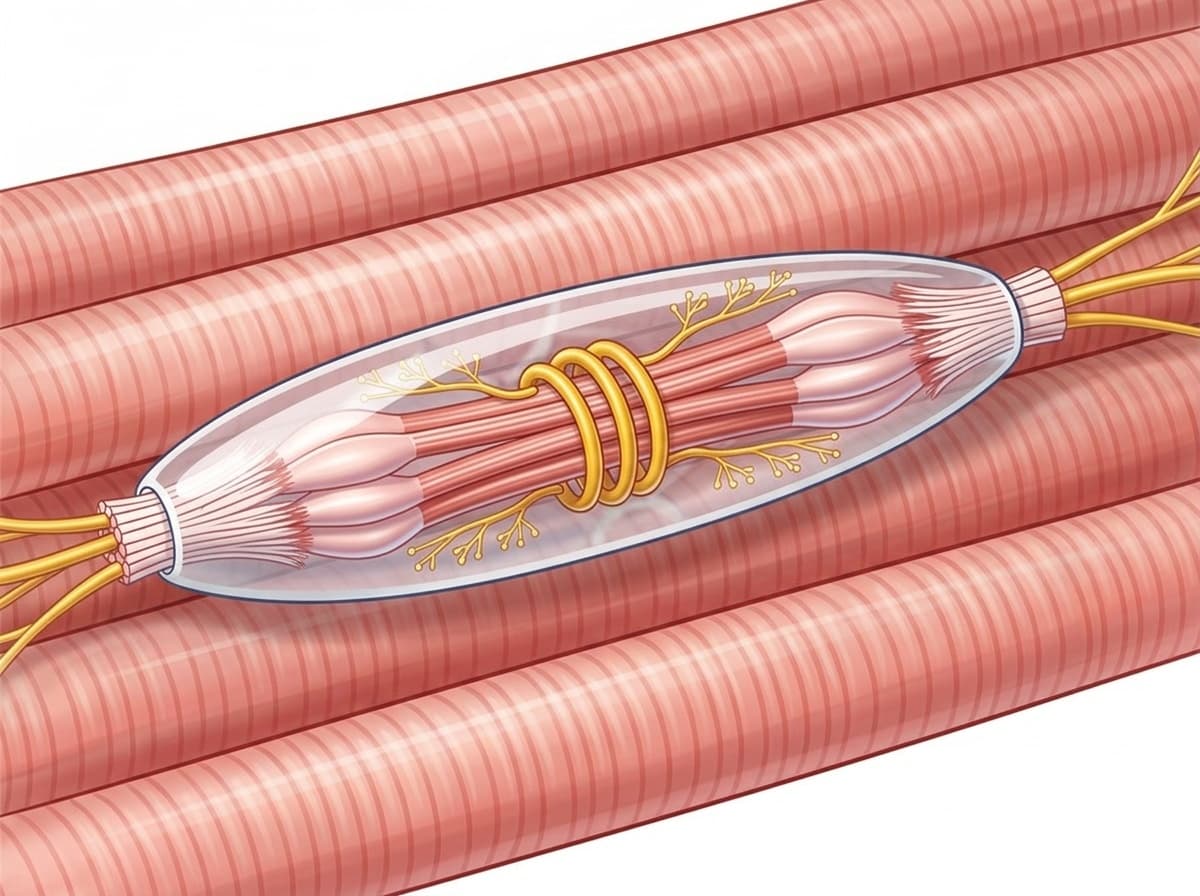
Lie perfectly still on a couch, and most of the sensors in your skin fall silent. Your muscle spindles keep talking.
That difference is easy to overlook, and it may be one of the most important facts in afferent neurophysiology.
Spontaneous Afferent Input from Muscle Spindles
When researchers record single spindle afferents in relaxed human muscle, many are firing with nothing happening at all.
- In relaxed forearm muscles, 54 spindle afferents fired at an average of 7.1 impulses per second, ranging from 0 to 24.
- In the wrist extensors, 15 of 25 primary endings were active at rest, with a median rate of 10.6 impulses per second.
- In the relaxed ankle and toe extensors, most spindles fired spontaneously.
Not every spindle is active. A third of the forearm sample had no background discharge. But across a muscle with hundreds of spindles, the result is a steady stream of afferent input whenever the muscle exists, not just when it moves.
Skin Receptors Wait to Be Disturbed
Skin works differently. During a precision grip, the fast-adapting touch receptors were virtually silent between lifts, then burst into activity at the moment of contact.
The slowly adapting type I receptors, which report sustained pressure, showed no spontaneous discharge at all.
So, broadly, skin reports events: something touched you, something moved, something changed.
Ligament and Joint Receptors Wake Up at the Edges
Ligament and joint receptors are no different. When Burgess and Clark recorded from the cat knee joint, fewer than 5% of receptors fired in the middle of the range. Most only respond near the end of the range, when a ligament is loaded.
At rest, in a comfortable position, they're largely quiet. With one striking exception, in the mouth.
The Exception: Periodontal Ligament Receptors
Every tooth is suspended in its socket by a ligament, and that ligament breaks the rule.
When Mats Trulsson and colleagues recorded from periodontal afferents in awake human volunteers, every one was slowly adapting. Each kept firing for as long as a force was held on the tooth in at least one direction.
Unlike the knee, they don't wait for the end of the range. Most are most sensitive at very low forces, which makes them ideal for signalling gentle contact as we position and manipulate food. Only a minority track the hard forces of biting and chewing.
They also behave like a population of spindles. A single afferent gives an ambiguous signal about which way a tooth is being pushed. The population together gives detailed directional information.
And they distinguish a tap from a push. A brisk tap on an incisor tones down the masseter within 13 milliseconds, a protective reflex that stops us biting hard on something unexpected. A slow push produces a later excitation instead, probably helping us grip food between the teeth. Numb the tissues around the tooth with local anaesthetic, and both responses disappear.
The teeth sit in a ligament that listens like a muscle.
Whether periodontal receptors idle at rest the way spindles do is less certain. Many recordings show spontaneous firing, but one animal study found it only appeared after the sympathetic nerve supply had been cut. What isn't in doubt is that they report small, everyday loads continuously, rather than waiting for the extremes.
Skin and ligaments report events. Muscle spindles report a state.
Why Spontaneous Afferent Input Matters
A sensor that's always firing can signal change in both directions. When a resting spindle speeds up, the muscle is lengthening. When it slows or stops, the muscle is shortening, or something has toned the spindle down. A silent sensor can only signal "more."
That baseline also seems to belong to the spindle itself. In people with complete spinal cord injury, resting spindle firing rates and their variability were the same as in uninjured people. Whatever keeps the spindle idling doesn't depend on drive from the brain.
The spindle ending even maintains its own sensitivity. Stretching it releases glutamate from tiny vesicles inside the ending, and that glutamate tunes how readily it fires. Block the receptor it acts on, and stretch-evoked firing stops completely.
Afferent input is the battery of your brain. The muscle spindles are the trickle charge that never stops.
The Spindle Baseline Moves
The idling rate isn't fixed. After a few voluntary contractions of the ankle dorsiflexors, 19 of 55 spindle afferents kept firing faster than before, and 10 of those had been silent. The average resting rate across all 55 rose by 65%, from 2.3 to 3.9 impulses per second.
A simple stretch of the muscle reduced or removed that raised rate in 12 of 14 cases.
So what a muscle has just done changes the background input it sends at rest. That matters for anyone who tests muscles, because the input a patient brings to the table depends on what they did in the minutes before.
Not the Only Voice
None of this means spindles are the only important input. Skin receptors are far more numerous, and they dominate whenever we touch, grip or move against something.
But they mostly speak when spoken to. The spindles are the one large population of sensors that keep reporting when nothing is happening.
If afferent input is what the nervous system runs on, then the muscles aren't just the body's motors. They're its main continuous source of information about itself.
To your strength!