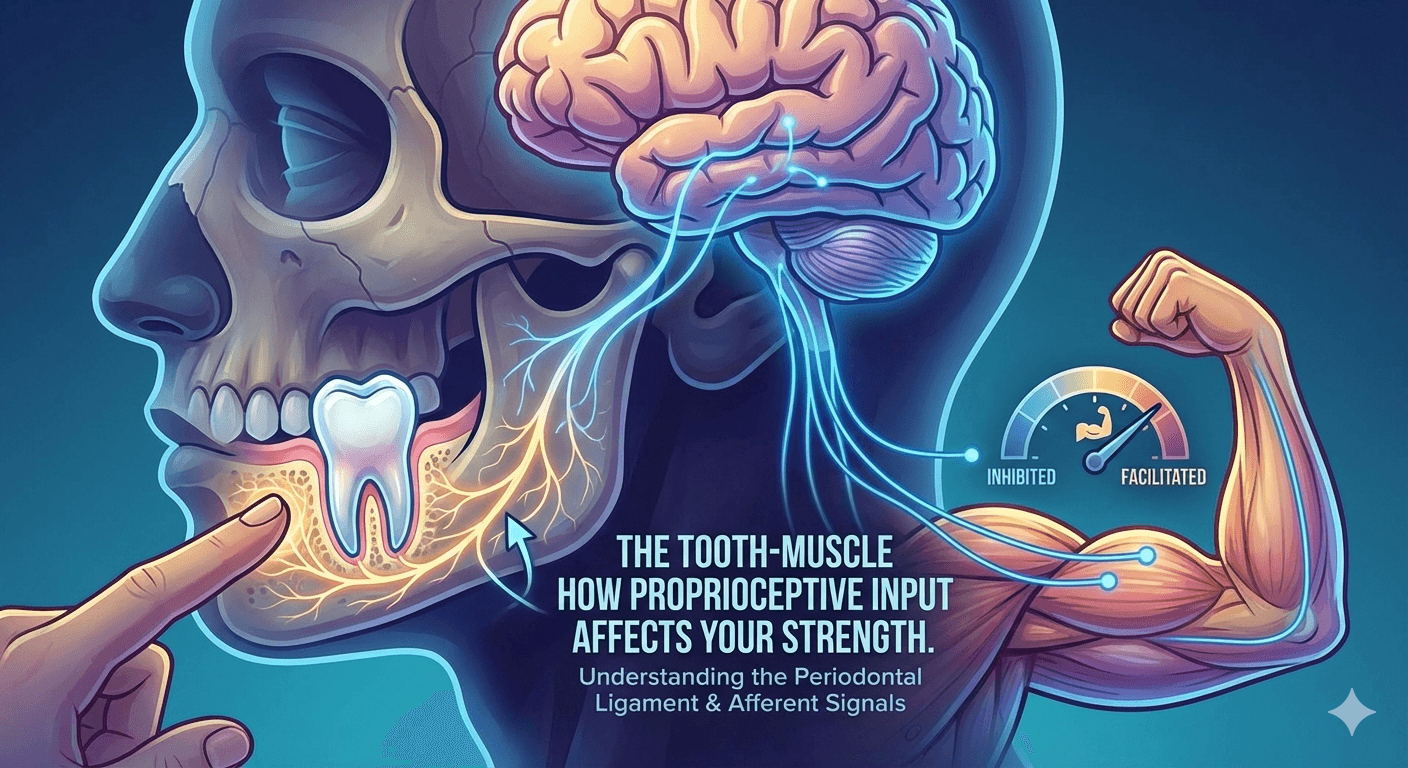
Clinical Insights into Proprioceptive Insults and Neurological Motor Output
In manual therapy, we often look to the spine or the extremities to resolve motor dysfunction. However, for the Afferentologist, the mouth represents one of the most significant sources of afferent input in the human body. When we "touch" a tooth during a clinical exam, we aren't just checking for dental decay; we are interfacing with a sophisticated neural gateway that governs systemic muscle tone.
Teeth are intimately wired into the central nervous system. Any disruption to this input—whether through metal amalgams, crowns, or "galvanism"—can create a "Software" error that manifests as remote muscle weakness and postural instability.
The Periodontal Ligament: The Brain’s Tension Sensor
To understand why dental work affects strength, we must look at the periodontal ligament (PDL). Unlike other ligaments that merely anchor structure, the PDL is a high-density sensory organ. It is packed with receptors that function similarly to muscle spindles, providing a constant 50Hz resting tone to the brain.
These sensors detect micron-level changes in compression, traction, and direction. This high level of sensitivity is why even a tiny piece of hair or a grain of sand between the teeth feels like a significant obstruction. This data stream feeds directly into the sensory homunculus, an area of the brain with a massive cortical representation for the mouth and lips, and a direct, high-speed connection to motor centers.
Facilitation vs. Inhibition: The Turker Study
In 1994, groundbreaking research by Dr. Kemal Turker in the Journal of Experimental Brain Research quantified how dental stimuli dictate muscle strength. Using electrodes in the masseter muscles, researchers found two distinct responses to tooth stimulation:
- The Facilitatory Response: Slow, steady pressure (simulating biting into hard food) facilitated the biting muscles, making them stronger to meet the resistance.
- The Inhibitory Response: A brisk tap (simulating biting a stone or unexpected hard object) caused immediate neurological inhibition. The muscles "switched off" to protect the tooth from fracture.
This is the Withdrawal Reflex in action. When you bite something hard unexpectedly, it isn't just your jaw that drops; your entire body flinches. This systemic reaction—involving the neck, core, and even the extremities—is a reflex response to a perceived proprioceptive insult.
The "Nail in the Tooth": Amalgams and Metal Crowns
Metal restorations act as a persistent, low-grade "Nail in the Foot." Foreign bodies like amalgam fillings and metal crowns have the power to alter the afferent signals sent to the brain. In many cases, these materials simulate the inhibitory signal associated with a sudden tap or trauma.
Because the brain receives a constant signal of "threat" from the tooth, it keeps the associated motor chain in a state of chronic inhibition. This isn't a "hardware" failure of the muscle; it is a software protection mechanism. The patient presents with weakness that won't respond to exercise because the brain is intentionally keeping the muscle "off-line."
Restoring Normal Output
In the clinic, we test this by applying firm, facilitatory pressure to the tooth (often having the patient bite on a cotton roll). If this stimulus temporarily restores strength to an inhibited muscle, we have confirmed a dental afferent problem.
We are not "making the patient stronger" in a traditional sense. We are simply removing the inhibition. By identifying and neutralizing these bad sensory inputs—often requiring the removal of offending metal by a biological dentist—we allow the normalization of the afferent stream, restoring the body's natural, functional strength.