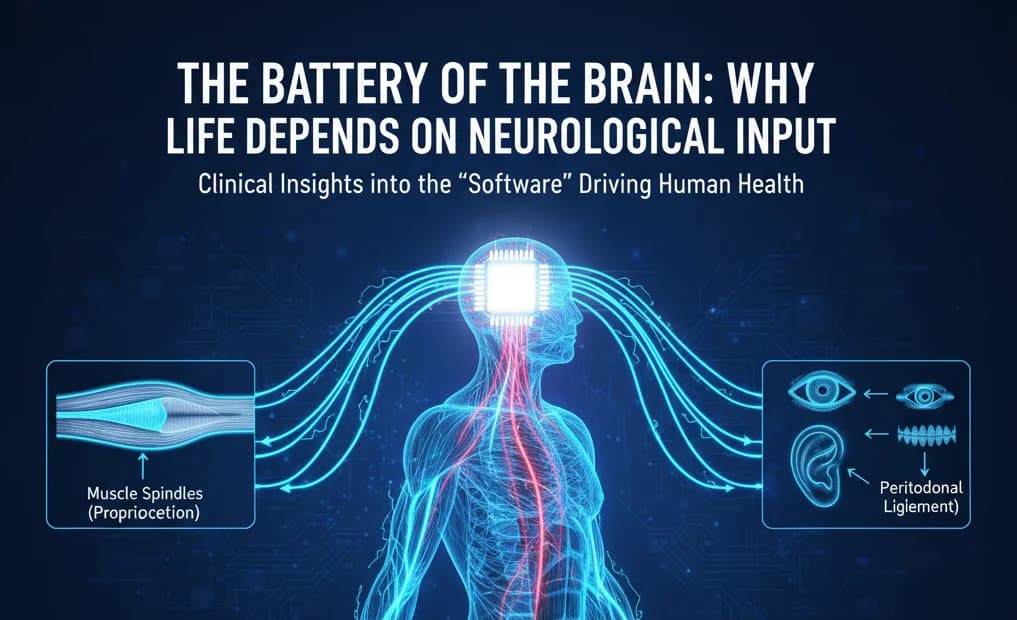
Unlike inanimate objects, the human body is a dynamic, self-regulating system that constantly adapts to its environment. While traditional biomechanical models treat the body as a static "structure," Afferentology recognizes that health is a byproduct of high-fidelity data processing. At its core, the quality of our health is determined by the quality of our inputs.
For more complex beings, a nervous system is the ultimate evolutionary advantage, allowing us to react to and resist environmental forces. However, this system requires a unique form of fuel to function: the electrical messages known as afferent impulses.
The Central Nervous System as a Processing Hub
It is a common clinical misconception that thoughts alone govern actions or that the brain "starts" the activity of the body. In reality, the brain and spinal cord cannot produce nerve messages in a vacuum. The brain is a processing center, not a generator. It requires constant, streaming input to maintain its 50Hz resting tone.
Think of the brain as a high-performance computer. Without a keyboard (sensory receptors) or an internet connection (the peripheral nervous system), it does nothing. If you drive a "nail" through the keyboard or fray the ethernet cable, the output on the screen becomes distorted, unreliable, and glitchy. In the body, this "distorted output" manifests as chronic pain, instability, and weakness.
The Hierarchy of Neural Inputs
Not all neural inputs are created equal. While many sensors, like those in the skin, only fire when stimulated (modifying existing data), only a few cell types provide the continuous "charge" the central nervous system needs to stay "awake." These primary generators include:
- Muscle Spindles: Constant data on length and tension.
- Periodontal Ligaments: High-density sensors surrounding the teeth.
- Vestibular and Visual Sensors: Balance and spatial orientation.
This interplay between constant sensory input and the resulting motor output is what governs our reaction to the world. When this system is compromised by "bad data," the brain enters a protective state of neurological inhibition.
Software Errors: From Paralysis to Chronic Pain
Abnormal input inevitably causes faulty output. While severe "hardware" failures like a stroke result in paralysis or spasticity, most clinical cases involve subtle changes in muscle tone. This is the software vs. hardware distinction: the muscle isn't physically damaged; its control signal has been compromised.
The Foreign Body Reflex
We intuitively understand the "Nail in the Foot" analogy. A pebble in your shoe causes an immediate limp. No amount of time in the gym or "strengthening" the leg will fix that limp until the pebble is removed. This is because reflexes control muscle tone, not exercise.
In the modern patient, these "pebbles" are often hidden—old surgical scars, dental amalgams, or piercings. These foreign bodies provide a constant stream of aberrant input, causing the brain to "switch off" certain muscles to protect the system. This leads to muscle tightness (causing aches) or muscle weakness (leaving joints vulnerable to sprains and osteoarthritis).
Conclusion: Restoring the Normal Healing Response
Afferentologists specialize in the precision testing of these neurological inputs. By identifying and correcting the abnormal afferent signal, we allow the brain to reset its motor output. We don't just treat the pain; we restore the "battery" and the "software" of the human body.
Ultimately, health depends on the integrity of this loop. Without high-quality input, we lose the advantage of movement—and without movement, we may as well be rocks.
Medical Disclaimer: This article is based upon the opinions of Simon King. The information on this website is not intended to replace a one-on-one relationship with a qualified health care professional and is not intended as medical advice. It is intended as a sharing of knowledge and information from the research and experience of Simon King and his associates. Simon King encourages you to make your own health care decisions based upon your research and in partnership with a qualified health care professional.