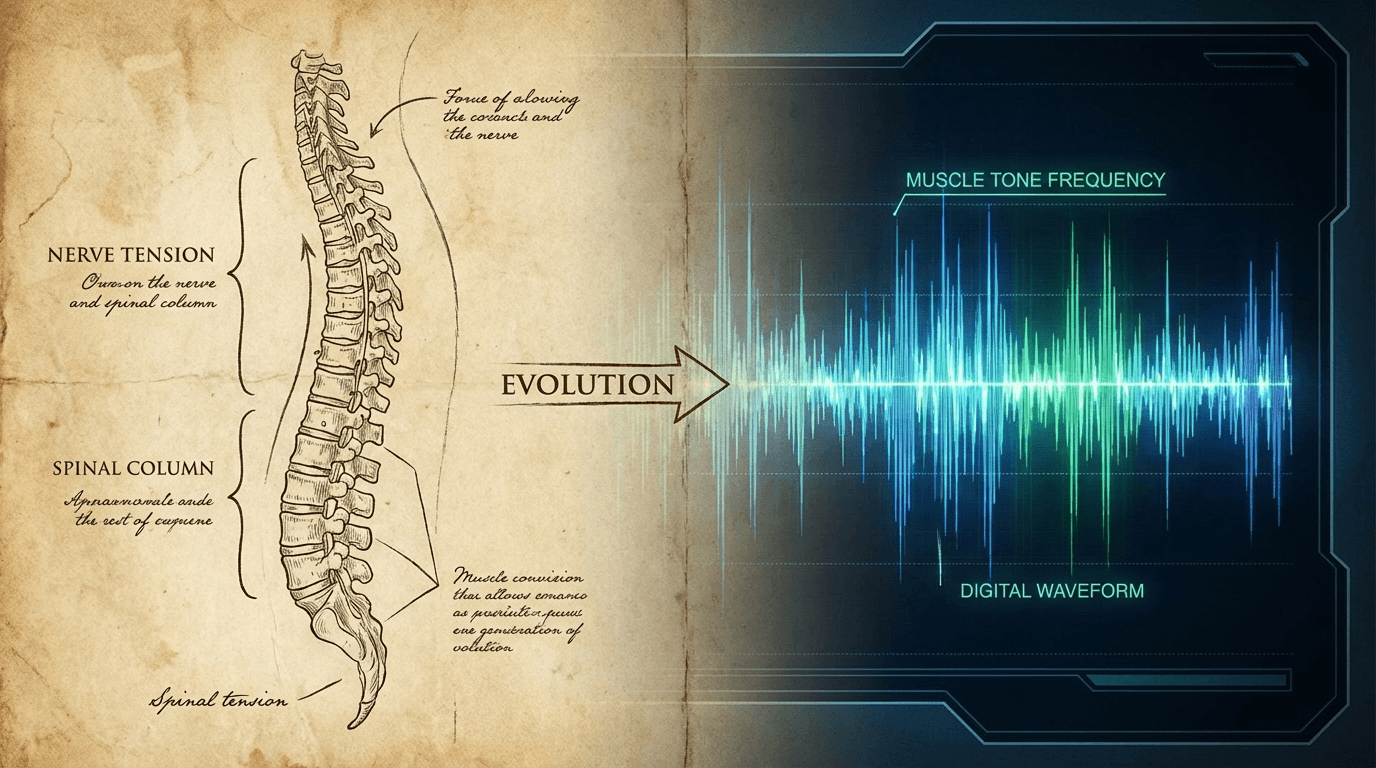
In 1910, the founder of chiropractic made a radical claim: "Life is the expression of tone." While he intuited the importance of neurological frequency, modern science reveals that Palmer had the right idea—but he was looking at the wrong source.
DD Palmer was a visionary. He saw the human body not as a collection of static parts, but as a vibrating, electrical system. He believed health was defined by a precise "nerve tension." However, Palmer was a man of his time; he believed this Tone originated purely within the nerves themselves. He sensed the frequency of health, but he couldn't have known that the "radio station" broadcasting that frequency is actually the interaction between the muscle spindle and the motor neuron.
The 50Hz Tone: The Source Palmer Couldn't See
Today, groundbreaking research in Neurology has provided the "smoking gun" that Palmer was missing. We now know that what he called "Tone" is actually a high-speed dialogue. It isn't a static tension held in the nerve; it is a dynamic 50Hz resting tone generated by motor neurons in response to data from the muscles.
Muscle tone is the true basis of health, but it is a signal transmitted by nerves. The muscle spindle acts as the primary Afferent sensor, measuring the "Internal Yank" and force within the tissue. It sends this data to the motor neuron—a tiny accountant receiving 10,000 different inputs—to determine the final "voltage" of the system.
"Palmer had the right vision but the wrong mechanism. He saw the 'nerve tension-frame,' but we now know the muscle is the broadcaster and the nerve is simply the high-speed fiber-optic cable."
The Data Analyst vs. The Panel Beater
Because Palmer lacked the modern understanding of Alpha-Gamma motor neuron interactions, the profession he founded often devolved into "Panel Beating"—manually forcing a "fixated" bone back into place as if it were a dented fender. But a joint fixation isn't a structural error; it's a Withdrawal Reflex.
In our Clinical Residency, we move beyond the "Panel Beater" mentality. We act as Data Analysts. We recognize that the brain "locks" a joint because it has detected a threat elsewhere—a Nail in the Foot. The brain has mathematically concluded that lowering the voltage on the Neurological Voltmeter is the safest survival strategy.
The Software Reboot: Restoring the Frequency
When we find a muscle that has lost its tone, we don't just "beat the panel." We look for the Afferent irritant that is corrupting the signal. By clearing this interference, we aren't just moving bones; we are updating the software. This allows the 50Hz frequency to return naturally, restoring the "Life Expression" Palmer dreamed of.
Clinical Takeaways for the Modern Practitioner
- Tone is the Driver: Health and stability are direct expressions of muscle tone, which is a neurological output.
- The Muscle as Broadcaster: The spindle provides the data that sets the tone. Treat the sensor, not just the "cable."
- Stop the Panel Beating: Joint fixations are deliberate neurological calculations. Find the "bad data" (afferent irritant) to unlock the joint.
- The 50Hz Standard: Use Protective Reflex Testing as your diagnostic tool to measure the voltage of the software, not the strength of the hardware.