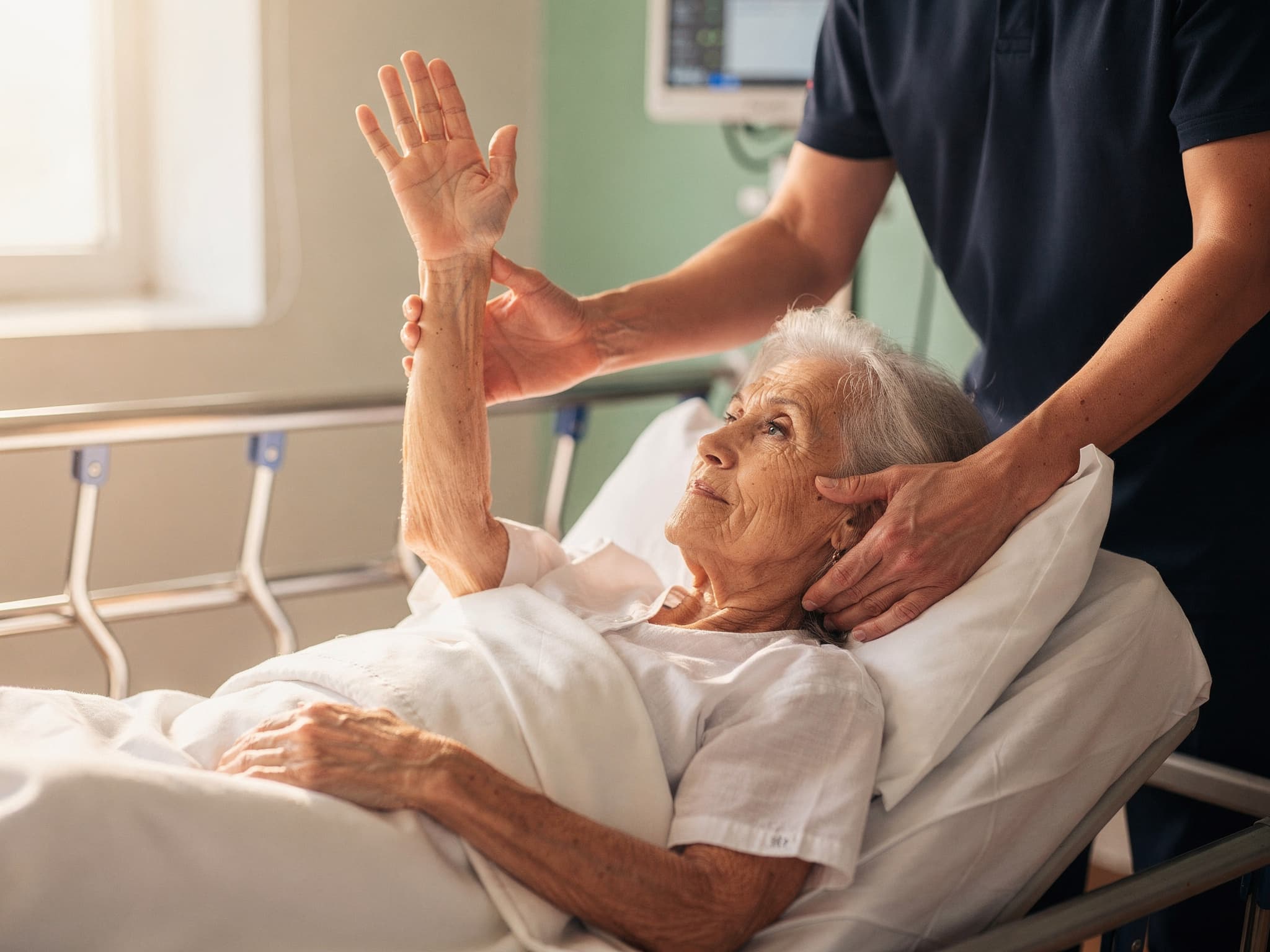
A woman in her sixties came to see me eighteen months after a shoulder operation. The surgery had gone well. The scans were clean. Everyone had signed her off. But she couldn't hold a full kettle at arm's length, and nobody had ever asked her to try.
Her hardware was fine; nothing to see. Her function wasn't. She still had muscle inhibition. And here is the thing that should bother all of us: in eighteen months of contact with the healthcare system, not one person had tested her arm abduction, and if they did, they didn’t know what to do about it.
Why Nobody Measures Your Strength
We measure blood pressure. We measure cholesterol, HbA1c, eGFR, ferritin. We image joints in extraordinary detail. We almost never measure whether your muscles work, although I’m sure that would change if there was a drug for muscle inhibition.
We almost never measure whether your muscles work.
When strength does get measured, it's usually with a handgrip dynamometer; squeeze this, we'll write down a number. It's quick, it's objective, and it feels like proper science. Manual muscle testing, by contrast; a practitioner's hands against your limb; gets treated as the soft option. Subjective. Old-fashioned. Not quite real data.
The evidence says the opposite.
The Study That Should Have Changed Practice
In 2012, a team working in a large American academic hospital published a study in Physical Therapy that has never received the attention it deserves.
They took 107 patients in a surgical intensive care unit and measured their strength two ways: manual muscle testing using the Medical Research Council scale, and handgrip dynamometry. Then they followed what happened to those patients.
Manual muscle testing independently predicted four things: whether the patient died in hospital, how long they stayed in intensive care, how long they stayed in hospital, and how many days they spent on a ventilator.
Handgrip strength independently predicted none of them.
"The hands beat the machine. Not because the machine was inaccurate, but because it was asking the wrong question; one muscle, one moment, one hand."
That is the entire argument in a sentence. A dynamometer measures the output of a single grip. Manual muscle testing samples the nervous system across the whole body; multiple muscle groups, both sides, multiple spinal cord levels. It isn't a strength test. It's a survey of neurological integrity, and neurological integrity is what predicts whether you go home.
Strength Is Not Fitness. It Is Neurological Output.
This is where conventional thinking goes wrong, and it goes wrong early.
Strength is treated as a fitness variable; something you build in a gym, something that reflects how much exercise you've done. So when someone is weak, the answer is exercise.
But muscle doesn't decide anything. The motor neuron decides. Your muscles hold their resting tone because motor neurons fire at them continuously, and they generate force because the nervous system tells them to. Take away the signal and the muscle is a piece of meat with a good blood supply.
That's why a manual muscle test carries prognostic information a squeeze meter doesn't. You're not reading the muscle. You're reading the state of the system driving it.
Weakness Happens in Days, Not Months
If you think this is a slow, geriatric process, look at how fast it moves.
A 2023 study in Nursing in Critical Care tracked muscle strength in intensive care patients on days 1, 4 and 7. By day four, 80% of the COVID patients and 40% of the non-COVID patients met the criteria for ICU-acquired weakness. By day seven, effectively all of them did.
Four days. Nobody loses meaningful muscle bulk in four days, but you do if you're confined to bed in the ICU. That's why reducing length of stay is important.
Grip strength does carry information in the right, narrow context. A 2018 pilot study in The Clinical Respiratory Journal found that in ventilated COPD patients, lower grip strength tracked with longer ventilation, and day-five grip was lower in those who died or needed reintubating. That's a real finding. But note what it took: a single disease, a single question, a captive population. Widen the population and the local measure loses to the global one.
And by the time weakness shows up structurally, you're late. A 2025 study in the European Journal of Radiology found sarcopenia on chest CT in 57% of critically ill COPD patients, and roughly double the risk of dying (hazard ratio 2.31). Useful. But a CT is a lagging indicator. It shows you the muscle that has already gone.
ICU is a Stress For the Body
I have always maintained that Health is the ability to withstand or overcome an external force. External forces or stressors are part of life, but a stay in the ICU is a particularly challenging one. Fortunately, the MMT study allows us to measure an individual's reaction to this particular stress.
Many studies of strength have shown that strength is associated with quality of life and longevity. Length of stay is a more readily accessible measure of health than mortality. We hope that more studies of MMT can be applied to similar life stressors.
Strength is not a fitness score. It is a reading of your nervous system.
Protective Reflex Testing exists to do exactly this; find the input that's holding the muscle offline, remove it, and watch the strength return in real time. Not over six weeks. In the room.
The intensive care researchers found what they found because they put their hands on people and asked the muscles a question. That's not a soft test. On the evidence, it's the sharpest one we have.
To your strength!