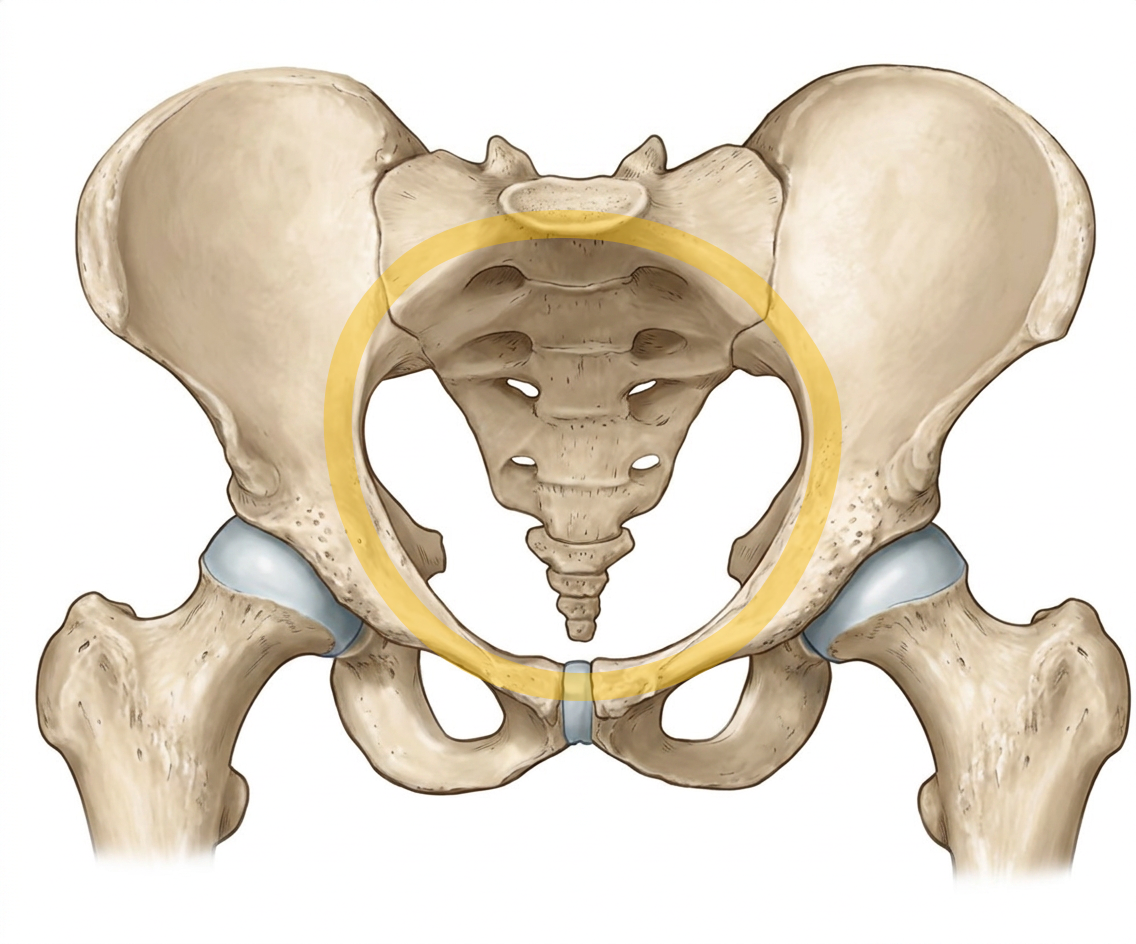
The sacroiliac joint has no intrinsic muscular control. The SIJ cannot be actively stabilised by muscles that cross it directly, its stability depends entirely on the tone and integrity of the pelvic ring and surrounding musculature.
The pelvis isn't three separate bones. It's one ring.
Most people picture the pelvis as a bony bowl. It's actually a closed ring — the sacrum at the back, the two ilia wrapping round the sides, and the pubic symphysis locking it shut at the front. Three joints hold that ring together: two sacroiliac joints and the pubic symphysis. Take any one of them out of the picture and the ring stops behaving like a ring.
Why the ring matters more than the joint
The spine doesn't stand on the sacrum the way a pole stands on a plinth. It stands on a ring that's designed to close down slightly under load — the "self-locking" mechanism, driven by the wedge shape of the sacrum and the tension in the surrounding ligaments and muscles (glute max, latissimus, the thoracolumbar fascia). When that locking mechanism works, force from the legs transfers up through the ring into the spine cleanly. When one side of the ring is inhibited, a glute that isn't firing, a hip flexor stuck short, an old fall onto one ischial tuberosity, the ring stops closing evenly. The spine above it compensates, and that's usually where the pain shows up. Not at the ring. Above it.
Afferentology treats sacroiliac joint pain as a software diagnosis. The joint is not stained, the joints are not out of place, it is mechanically vulnerable because the muscles that are supposed to compress and protect it have been neurologically withdrawn. The SIJ is stable when the surrounding muscle software is running correctly. When it is not, the joint becomes symptomatic under loads that should be managed without discomfort. The question is always the same: which muscles are inhibited, and what afferent source is inhibiting them?
The SIJ Stability System: Compression, Form Closure, and the Muscle Software
Standard SIJ assessment involves palpation of joint mobility, provocation tests — the posterior shear test, the compression test, the FABER test — and imaging to exclude fracture or sacroiliitis. None of these tests assess the neurological integrity of the surrounding musculature. A patient who tests positive on three SIJ provocation tests and whose imaging shows no structural pathology is being assessed for hardware in a condition that is fundamentally a software problem.
"The sacroiliac joint is not unstable because it is weak or diseased. It is unstable because the muscles that create force closure have been neurologically withdrawn. The joint is performing exactly as a well-designed joint would perform when its active stabilisation system has been switched off."
What Is Driving the Inhibition
While there are a few afferent sources that might cause the muscular inhibition that drives SIJ instability, by far the most common is a subclinical inguinal hernia. This is a direct hernia, where there is disruption or irritation to the posterior inguinal canal. There is no bulge and it cannot be seen from the front.
The Software Test: Protective Reflex Testing
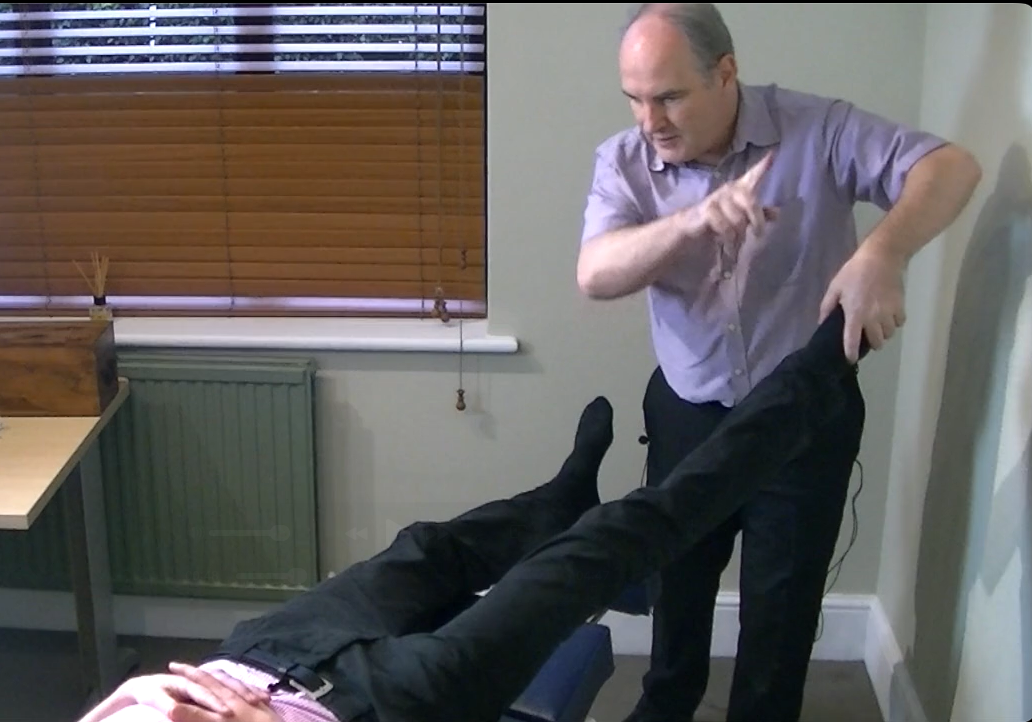
The direct inguinal hernia produces a weakness in the hip that can be detected with a specific muscle test.
The test is done with the patient supine and their straight leg moved actively into extreme abduction flexion and external rotation. The doctor then gently holds their ankle and asks the patient to pull further into abduction, flexion and external rotation (up and out to the corner of the room).
Reasonable continued power into that direction is a negative test. Immediate failure or weakness of the test is positive and indicates a possible inguinal hernia.
The good news for manually proficient practitioners is that such hernias respond readily to manipulation which reduces the inguinal hernia, often with immediate and lasting resolution to the SI joint irritation and pain.
Clinical Takeaways
- The SIJ is always a secondary diagnosis in the Afferentology model: The joint cannot be rehabilitated in isolation from the muscles that stabilise it. The clinical question is never "what is wrong with the SIJ?" — it is "which muscles are failing to stabilise the SIJ, and what is inhibiting them?"
- SIJ belts and manual therapy address the hardware, not the software: An SIJ support belt compensates for lost force closure by providing passive compression. It is a reasonable transitional measure. It does not restore the motor neuron supply to the gluteus medius or the transversus abdominis. PRT should identify the afferent source while the belt is being worn, not instead of it.
- Post-partum SIJ pain has a specific afferent architecture: A woman with post-partum SIJ pain has multiple candidate afferent sources: the birth trauma itself, the Caesarean scar if applicable, the hormonal ligamentous laxity affecting mechanoreceptor sensitivity, and the changed biomechanics of the immediate post-partum period. Each must be assessed systematically with PRT.
- Blocking often produces temporary and limited effects: Using DeJarnette blocks is of limited usefulness if the real problem is an inguinal hernia. In practice, fixing the hernia eliminates the need for blocking most of the time.
SIJ pain is not a joint problem. It is a software problem that the joint is displaying.
The sacroiliac joint has no muscular control of its own. Its stability is entirely dependent on the software surrounding it. When the software fails, the joint fails. Restore the software, and the joint is stable again. It is genuinely that direct.