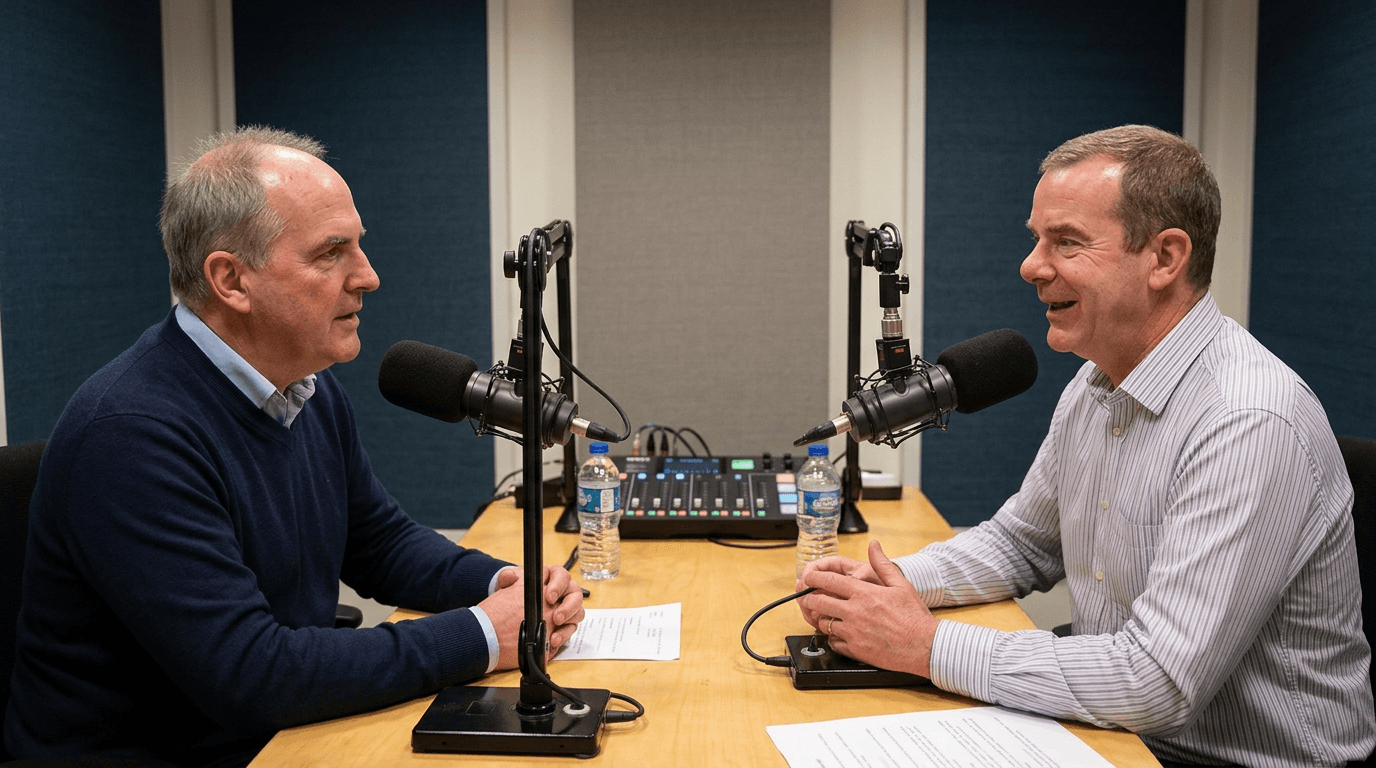
Some years ago I interviewed Professor Mike Hurley, then at King's College London. If you search for research on muscle strength and proprioception, his name comes up. He is one of the most cited people in the field, and he was generous with an hour of his time.
Near the end I asked him the question I'd been building towards for the whole conversation.
We had already agreed on something most people get backwards. And I want to be clear how significant that agreement was, because it isn't a fringe position when a professor of physiotherapy says it.
The Reversal
The standard account of arthritis goes like this. The joint is damaged. The damage hurts. Pain makes you avoid using the limb. Disuse wastes the muscle. So the weakness we find in an arthritic knee is wreckage — a downstream consequence of a joint that wore out.
Hurley described that model to me, and then set it aside.
"We formulated a story a while ago that said, actually, maybe it's a decrease in muscle function, initially at the start, that's actually exposing the joint to kind of initial degeneration."
Weakness first. Damage second. That's the reversal, and it's the position he had published in 1999, arguing that motor and sensory dysfunction of muscle may cause joint damage rather than simply follow it.
So I asked whether that model was established now.
The Answer That Should Be Better Known
His reply is the single most useful thing anybody has said to me about this subject.
"One of the problems is to actually find and get evidence to link that in is extremely difficult. You really have to do lots of long-term epidemiological studies in large numbers of people. And frankly, the bottom line is those things are very costly to set up and very difficult to carry out. But the indirect evidence that we can give actually makes a very powerful argument for this being at least a cause in some people."
The weakness-causes-arthritis model has not been tested and rejected. It has never been tested properly, because the study that would settle it costs more than anyone will pay. His own ESCAPE trial ran to around £650,000, and that was a rehabilitation trial, not a thirty-year cohort study.
This matters enormously, and almost nobody says it out loud. When you are told the evidence doesn't support a position, you assume someone looked and found nothing. Sometimes nobody looked, because looking was unaffordable.
That is a completely different situation, and it should change how confidently the conventional view gets asserted.
Then I Asked the Real Question
Late in the conversation I put it to him plainly. If muscle weakness is the cause of the joint damage — what causes the weakness?
His answer, in full: joint injuries. Being overweight. Certain occupational activities. Then people get pain, they withdraw from activity, the muscles get weaker. And finally:
"The prevalence of osteoarthritis increases as people get old. It may well just be that as we get old, our muscle function changes, we get weaker. Proprioception isn't as sharp as it was before. So it's probably just an ageing process within muscles."
Look carefully at what happened there.
He opened the interview by rejecting the disuse-atrophy model; pain, withdrawal, wasting. Forty minutes later, asked what actually causes the weakness, he reached for pain, withdrawal and wasting. And then for ageing.
I don't say that to catch him out. I say it because it shows how few options are available once you've excluded the one that isn't on the menu.
Why He Went Where He Went
He was honest about this too, and I've never forgotten it.
"The muscle is the one that we can change the easiest. We can do exercises that will improve strength. We can do exercises that seem to improve proprioception... I can't do anything with cartilage. You can't do anything really with bone."
That is the reasoning. Not that exercise addresses the cause — that muscle is the tissue you can actually reach. It's a rational choice for a researcher who wants to help people this decade rather than the next one.
And by the end of our conversation he told me where it had taken him:
"I've kind of strayed much more over to health psychology and how people react to their illness."
Strayed. His word. He found the mechanism, said plainly that the proof was unaffordable, and then spent his career on the half of the problem he could move. ESCAPE helps people — its number needed to treat is seven, which is better than most drugs and not far off surgery. I have nothing but respect for the work.
But something kept nagging at me, and the trial data says it too.
The Gains Leak Away
He told me about a thirty-month follow-up, still preliminary at the time. Function was still better at two and a half years — but declining. And:
"The cost benefits were lost."
People drifted back to the GP, back to tablets, some on to surgery.
Then there was a second study comparing his community programme against standard hospital physiotherapy. His conclusion:
"Whatever you do to these patients, you're going to get an improvement in function... but there was no difference between the two groups."
If it doesn't matter much what exercise you give, the exercise may not be the active ingredient. And if the benefit erodes once the programme stops, something underneath was never changed.
I put a version of this to him at the time — that building a strong therapist relationship creates dependency, and that when you remove the therapist the patient goes backwards, because the underlying cause was never touched. He replied that there's no magic bullet, and we moved on.
He was being honest. There isn't one, in his framework.
The Nail in the Foot
Here is the option that wasn't on the menu.
Stand on a nail and your leg withdraws. That's a protective reflex, and it works by inhibiting the muscles that would drive your foot further onto the nail. Perfectly designed, entirely automatic, and it switches off when the nail comes out.
Now suppose the nail never comes out. Not a nail — a scar, an irritated disc, a dental input, an old ankle injury that healed structurally years ago. The reflex doesn't resolve. It settles in quietly at a lower volume, and the muscle stays partly offline. Not wasted. Not aged. Inhibited.
That muscle will test weak. It will fail to protect the joint it guards. And it will not respond properly to strengthening, because you cannot strengthen a muscle whose motor supply is being suppressed — you can only load a joint that has lost its guard.
Ageing doesn't explain why a fifty-year-old's quadriceps switches back on in a single session once the input is found. Ageing is what you reach for when you've run out of mechanisms.
Ageing is what you reach for when you've run out of mechanisms.
Professor Hurley did the hard, honest work. He identified the mechanism, admitted openly what couldn't be proven, and then went to work on what he could actually change.
The gap he left behind is where I've spent my career.
To your strength!
Our Heathrow seminar is coming soon. Book Now. →
Quotations are from a recorded interview with Professor Michael V. Hurley, lightly edited to remove verbal fillers. His published work on this subject includes "The role of muscle weakness in the pathogenesis of osteoarthritis," Rheumatic Disease Clinics of North America, 1999, and the ESCAPE trial, Arthritis Care & Research, 2007.
Mike qualified as a physiotherapist at Kings’ College Hospital in 1985. After completing his PhD at University College London he was Lecture, Reader and Professor at Kings College London between 1990-2010. In 2010 he became Research Lead in the School of Rehabilitation Sciences at St George’s University of London.
During his academic career Mike has contributed to many national working groups, clinical guideline committee and conferences, was a Clinical Advisor to Arthritis Research UK (2002-2008),Chair of Chartered Society of Physiotherapy’s Research and Clinical Effectiveness (2001-2004), and has authored over 75 scientific papers.