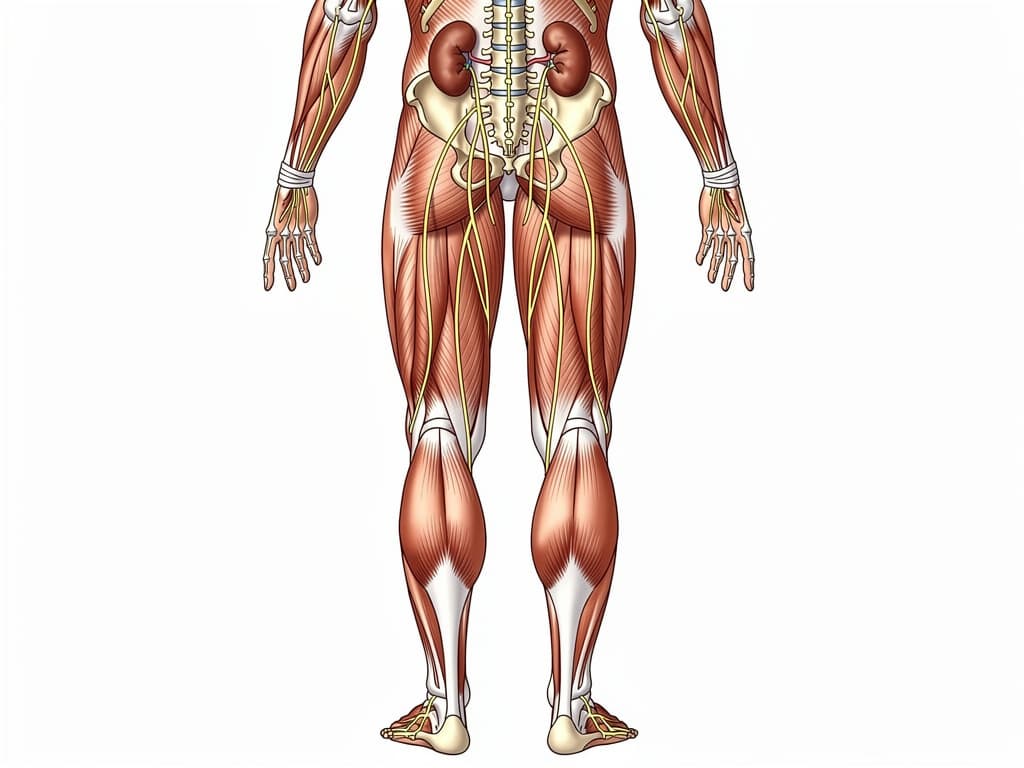
Essential hypertension is a medical mystery but treatments are focused on the heart, kidneys and blood vessels.
While the standard explanation for high blood pressure range of suspects: genetics, diet, excess sodium, obesity, stress and kidney disease, the clue is in the name. It's called essential hypertension because there is usually no identifiable cause.
Treatment follows the best guesses — antihypertensives, dietary restriction, weight loss. For many patients, none of it fully resolves the problem. Blood pressure remains elevated, medication doses creep up, and the underlying cause remains unaddressed.
What is almost never examined is the neurological input that governs kidney function in the first place: the muscle spindle reflex that drives renal sympathetic nerve activity, and what happens when that reflex is suppressed.
The Muscle–Kidney Reflex: Three Seconds to Triple Output
Victor and colleagues demonstrated in anesthetised cats that static contraction of the calf muscle tripled renal sympathetic nerve activity within three seconds of its onset. The effect was not gradual. It was immediate and proportional. More significantly, when the L6 and S2 dorsal nerve roots were severed, these are the nerve connections bringing messages from the muscles to the spine, the renal sympathetic response was abolished entirely. The kidney's sympathetic drive was not coming from the brain, it was coming from the muscle spindles in the calf, travelling up the dorsal roots, and driving renal sympathetic outflow at the spinal cord level.
The same group demonstrated that group III mechanoreceptors — the muscle spindles — were the specific afferent fibres responsible. Electrical stimulation of the tibial nerve at intensities that activated group III afferents reproduced the renal sympathetic response. It is a spindle reflex. The kidney listens to the muscles.
"Renal sympathetic nerve activity tripled within three seconds of muscle contraction onset, and dropped to zero when the spindle afferents were cut. The kidney was not regulating pressure independently. It was following a neurological instruction that came entirely from the muscle."
What Suppressed Muscle Tone Does to Blood Pressure
In Afferentology, this finding has immediate clinical implications. The withdrawal reflex, reduces cortical drive to some muscles and increases it to others. If the tnesion or tone in a muscle decreases their spindle output drops. The renal sympathetic signal they were providing is disrupted. The kidney is now receiving less sympathetic drive, does not regulate fluid volume and vascular resistance can rise. Blood pressure becomes dysregulated — not because the kidney is diseased, but because its sympathetic input has been compromised by an abnormal afferent input the patient and clinician have not identified.
The most common afferent sources driving this kind of systemic muscle inhibition include:
Why Exercise Lowers Blood Pressure — and What This Tells Us
The research on exercise and hypertension is consistent: aerobic exercise, particularly weight-bearing exercise, reduces blood pressure in hypertensive patients. The explanation offered is usually cardiac — reduced resting heart rate, improved vascular compliance. But the spindle research points to a more direct mechanism - exercise activates muscle spindle afferents. Those afferents drive kidney sympathetic stimulation. When the renal sympathetic signal is appropriate and responsive, kidney function, fluid handling, renin release, vascular resistance modulation are properly regulated.
The patient with inhibited muscle tone who goes for a run is temporarily restoring the afferent input their kidneys depend on. The blood pressure improvement is real, but it lasts only as long as the exercise is maintained — because the underlying loss of innate muscle tone has not been identified or removed. Find the afferent source, remove it, restore muscle tone permanently, and the exercise becomes rehabilitation rather than compensation.
Clinical Takeaways
- Renal sympathetic nerve activity is driven by muscle spindle afferents. This is not a theory, it was demonstrated directly in animal models, with the response abolished by severing the spindle afferent roots. The kidney takes instruction from the muscles.
- Inhibited muscle tone disrupts blood pressure regulation. Any afferent source that suppresses muscle tone reduces the spindle input the kidney depends on for appropriate sympathetic drive. Blood pressure dysregulation follows from the software failure, not from the kidney itself.
- Blood pressure that began rising after a dental procedure, surgery, or injury should trigger an afferent audit. The timing is clinical data. The afferent source that initiated the withdrawal reflex is identifiable using Protective Reflex Testing.
- Exercise helps — but removing the withdrawal reflex resolves. Exercise temporarily restores spindle-driven renal sympathetic output. Removing the afferent irritant driving the withdrawal reflex restores it permanently. These are not equivalent interventions.
The Kidney Is Not the Problem. The Signal Is.
Hypertension that does not fully respond to medication, dietary change, or lifestyle modification is frequently a neurological problem — specifically, a suppression of the muscle spindle afferent input that the kidney's sympathetic regulation depends upon. Find the withdrawal reflex. Remove the irritant. Restore the tone. The kidney will regulate blood pressure the way it was always designed to — not because it was treated, but because the signal it was waiting for has been restored.
Next time we will examine why exercise is not the answer to muscle tone