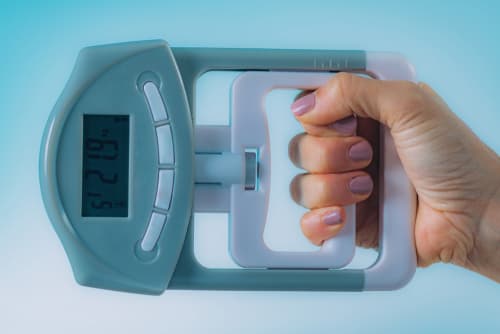
Research consistently shows a strong correlation between grip strength and overall health outcomes.
Research consistently shows a strong correlation between grip strength and overall health outcomes. Handgrip strength serves as a reliable biomarker for biological age and systemic health.
Understanding this connection helps explain why restoring muscle function through Afferentology can have such profound effects on overall wellbeing.
Categorized Clinical Evidence: The Impact of Strength on Health
While traditional medicine treats muscle strength as a byproduct of exercise, the following research suggests it is a primary indicator of biological age and neurological integrity.
| Clinical Category |
Key Finding |
Primary Reference |
| All-Cause Mortality |
Strength is a superior predictor of longevity compared to muscle mass; low grip strength correlates with a 33% higher death risk. |
BMJ Open (2022); The Lancet (2015) |
| Cardiometabolic Health |
Low normalized grip strength is a biomarker for pre-diabetes, type 2 diabetes, and cardiovascular disease events. |
Am J Prev Med (2019); Diabetes Care (2017) |
| Cognitive Function |
Declining grip strength serves as a means of monitoring the progression of cognitive decline and Alzheimer’s risk. |
Ageing Res Rev (2017); Neuroepidemiology (2007) |
| Respiratory Outcomes |
Grip strength predicts weaning success from ventilators and general prognosis in COPD patients. |
Clin Respir J (2018); Int J COPD (2017) |
| Post-Surgical Recovery |
Strength measures predict walking recovery after hip surgery and survival following cardiac interventions. |
Am J Med (2013); Open Heart (2014) |
| Neurological Drive |
Spinal manipulation can increase "cortical drive" and muscle output in athletes, confirming the "software" link. |
Eur J Appl Physiol (2018) |
The Afferentology Insight: Why Mass Isn't the Answer
Multiple studies (Newman et al., 2006; Menant et al., 2017) confirm that strength, not muscle mass, is the predictor of mortality. This validates our core concept: health is not about the size of the "hardware" (the muscle), but the efficiency of the "software" (the neurological signal).
Clinical References & Research
The following peer-reviewed studies provide the empirical basis for the relationship between neurological output (measured via grip strength) and systemic health outcomes.
-
Scherbov S, et al. (2022). Thresholds for clinical practice that directly link handgrip strength to remaining years of life.
BMJ Open 2022; doi:10.1136/bmjopen-2021-058489.
-
Mohamed-Hussein AA, et al. (2018). Association between Hand Grip Strength with Weaning and Intensive Care Outcomes in COPD Patients.
Clinical Respiratory Journal 12 (10). DOI: 10.1111/crj.12921.
-
Hu S, et al. (2019). Relationship Between Grip Strength and Prediabetes in a Large-Scale Adult Population.
American Journal of Preventive Medicine 56 (6). DOI: 10.1016/j.amepre.2019.01.013.
-
Manoy P, et al. (2017). Vitamin D Supplementation Improves Quality of Life and Physical Performance in Osteoarthritis Patients.
Nutrients. DOI: 10.3390/nu9080799.
-
Legrand D, et al. (2014). Muscle Strength and Physical Performance as Predictors of Mortality and Disability.
Journal of the American Geriatrics Society 62 (6). DOI: 10.1111/jgs.12840.
-
Victor RG, et al. (1989). Effects of Partial Neuromuscular Blockade on Sympathetic Nerve Responses.
Circulation Research 65 (2). DOI: 10.1161/01.RES.65.2.468.
-
Duchowny KA, et al. (2018). Muscle Weakness and Physical Disability in Older Americans.
Journal of Nutrition, Health and Aging 22 (4). PubMed: 24802886.
-
Dodds RM, et al. (2014). Grip Strength across the Life Course: Normative Data from Twelve British Studies.
PLoS ONE 9 (12). DOI: 10.1371/journal.pone.0113637.
-
Martien S, et al. (2015). Is Knee Extension Strength a Better Predictor than Handgrip Strength?
Archives of Gerontology and Geriatrics 60 (2). DOI: 10.1016/j.archger.2014.11.010.
-
Christiansen TL, et al. (2018). The Effects of a Single Session of Spinal Manipulation on Strength and Cortical Drive in Athletes.
European Journal of Applied Physiology 118 (4). DOI: 10.1007/s00421-018-3799-x.
-
Leong D, Teo K, Rangarajan S et al.
Prognostic value of grip strength: findings from the Prospective Urban Rural Epidemiology (PURE) study
The Lancet, 2015; 386, 266-273
https://www.thelancet.com/journals/lancet/article/PIIS0140-6736(14)62000-6/abstract
"Strength measures are better than muscle mass measures in predicting health-related outcomes in older people: Time to abandon the term Sarcopenia?" — Menant et al. (2017)