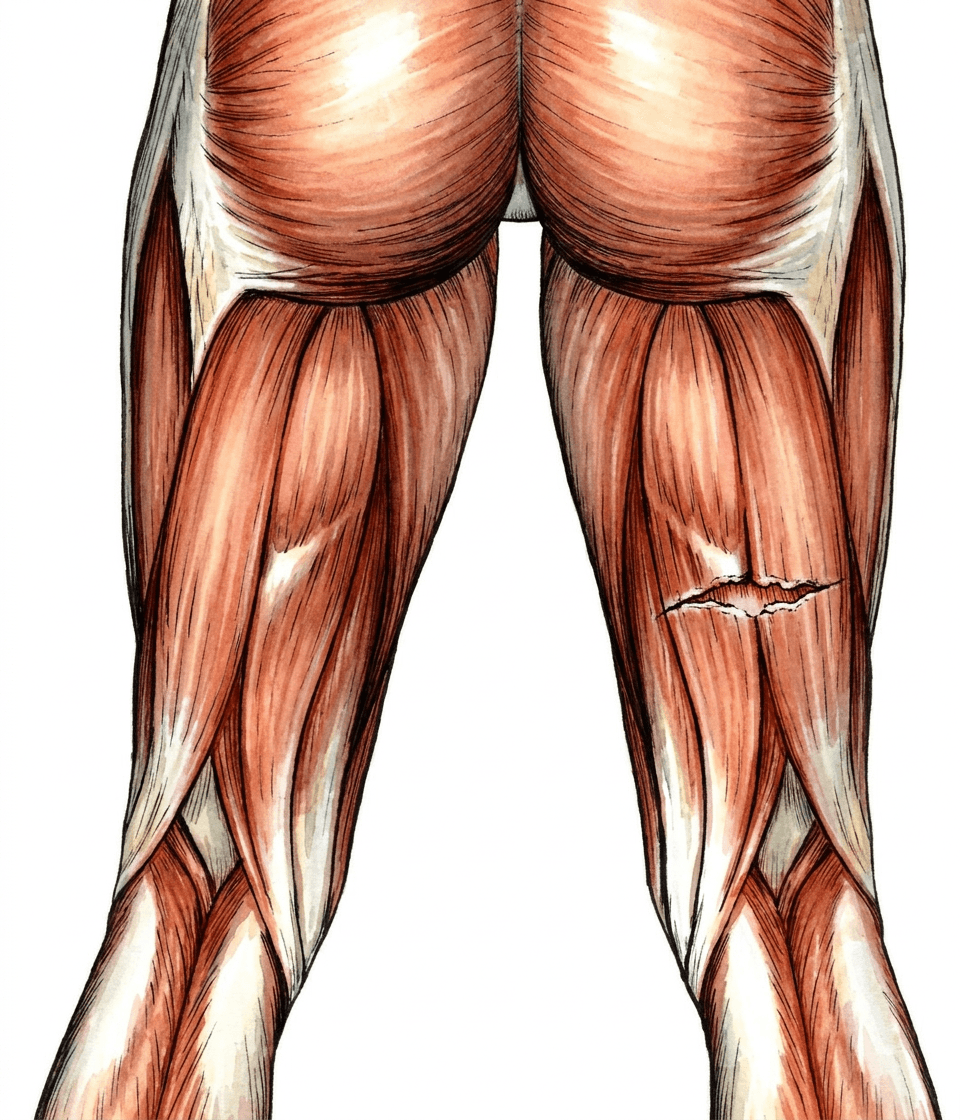
The hamstring is the most commonly strained muscle in many professional sports, and they have a very high recurrence rate. A player often strains their hamstring, undergoes rehabilitation, returns to play, and strains it again — sometimes within weeks. The rehabilitation literature documents this recurrence cycle extensively and attributes it to inadequate rehabilitation, premature return to play, or residual strength deficits. These factors are real but there is a hidden consideration that the literature largely ignores: the hamstring that strains repeatedly has a neurological signature that distinguishes it from the hamstring that strains once and does not recur.
Afferentology identifies the chronically strained hamstring as a muscle that is receiving a facilitated signal from the spinal cord — not an inhibited one. This is a crucial distinction. The hamstrings in a recurrent strain pattern are typically hypertonic, not weak. They are tight, guarded, resistant to stretching, and prone to sudden failure under eccentric load. The muscle is tight not because it is structurally shortened but because the nervous system has reacted to an insult by tightening it. Stretching a overly facilitated muscle does not address the reason it is tight.
Facilitation, Bracing, and the Withdrawal Reflex in Hamstring Strain
The hamstrings — biceps femoris long and short heads, semimembranosus, and semitendinosus — are supplied by the sciatic nerve from L4-S3. Their resting tone is maintained through the myotatic reflex arc at these cord levels. Under normal conditions, this tone is calibrated to the demands of the activity and is modulated dynamically during running and jumping. When an irritation from a hip, sacroiliac, pubic symphysis or other afferent source introduces an asymmetric facilitation signal at the L4-S2 cord level, the hamstrings are placed in a baseline state of elevated neural drive. The muscle is neurologically braced. Its extensibility is reduced not because the sarcomere length has changed but because the motor neuron pool is under increased drive. The clinician who stretches this hamstring and finds it unusually resistant to elongation is detecting a neurologically braced muscle, not a structurally shortened one. Stretching does not change the spinal cord's excessive output. The tightness returns within hours of each stretching session.
When the tight hamstring is subjected to sudden eccentric load, where the hamstring must decelerate the rapidly extending knee, the combination of elevated baseline tone and inadequate eccentric control produces the strain. The muscle is operating at the edge of its neurological and mechanical capacity before the load is applied. A normal eccentric demand becomes an injurious one in this neurological context. The strain occurs not because the muscle is weak or the athlete is unfit but because the added tone has placed the muscle in a state of mechanical vulnerability.
"The hamstring keeps straining not because it is tight — though it is — but because something is directing the spinal cord to keep it tight. That tightness removes the mechanical headroom the muscle needs to handle eccentric load. Find the afferent source and the tightness resolves. The strain stops recurring."
What Is Driving the Facilitation
The afferent sources most consistently maintaining hamstring facilitation in recurrent strain patients include:
- Ipsilateral hip and posterior hip capsule afferents: The posterior hip capsule is innervated by branches of the sciatic nerve and the posterior femoral cutaneous nerve. Hip pathology — a labral tear or posterior hip impingement, generates afferent input at the S1-S2 cord level that facilitates the ipsilateral hamstrings as part of the posterior hip protective reflex. The athlete with a hip problem they may not have recognised as significant has been playing with facilitated hamstrings — and a correspondingly elevated strain risk — throughout their season.
- Sacroiliac joint and sacral afferents: The SIJ and sacral plexus share cord segments with the hamstring nerve supply. SIJ dysfunction — from prior injury, asymmetric loading, or post-partum changes — generates withdrawal reflex facilitation of the ipsilateral posterior chain, including the hamstrings. An athlete with recurring ipsilateral hamstring strains and a history of SIJ pain is presenting with a pattern that has a clear neurological aetiological link.
- Hamstring strain scar tissue: Each hamstring strain heals with scar tissue at the muscle-tendon junction or within the muscle belly. As this scar matures, the mechanoreceptors within it generate afferent input that facilitates the surrounding muscle — the withdrawal reflex response to tissue that the nervous system reads as damaged. The more strains a player has sustained, the more scar tissue is present, and the higher the facilitatory afferent load on the hamstring motor neuron pool. The history of recurrent strain is itself the mechanism of future recurrence.
- Posterior abdominal and retroperitoneal afferents: The posterior abdominal wall — iliacus, psoas, and the retroperitoneal structures — shares cord segment innervation with the hamstring nerve supply at L4-S1. Chronic constipation, renal pathology, or retroperitoneal scarring from previous abdominal surgery generates persistent afferent input at these levels that maintains hamstring facilitation without the patient associating their tight hamstrings with their digestive or renal history.
The Software Test: Protective Reflex Testing
PRT in recurrent hamstring strain involves testing the hamstrings for both the pattern of facilitation — which muscles are overly contracted, on which side, and in what configuration — and for the inhibition pattern in the opposing muscle groups. A hamstring that is facilitated will typically be associated with ipsilateral quadriceps or hip flexor inhibition — the reciprocal inhibition pattern of the withdrawal reflex. The cord level of the facilitation is identified by the inhibition pattern in the reciprocal muscles. Afferent challenges are then applied to the candidate sources — hip capsule, SIJ, hamstring strain scars, posterior abdominal wall — and the facilitation pattern is retested after each challenge. When the correct source is identified, the hamstring facilitation resolves: the muscle's resting tone normalises, its passive extensibility increases immediately, and the reciprocal inhibition in the opposing muscles also resolves.
In clinical practice, the assessment and source identification typically produces an immediate, objective improvement in hamstring extensibility that is clearly visible — the straight leg raise range of motion increases measurably following correct afferent challenge. This is not a stretching effect. The sarcomere length has not changed. The motor neuron drive to the muscle has normalised, and the muscle is no longer neurologically braced.
Recurrent hamstring strain is not a muscle problem. It is a nervous system bracing a muscle it believes is threatened.
Find what the nervous system is responding to. Remove it. The hamstring decompresses. The eccentric capacity returns. The injury stops recurring. That is not rehabilitation. That is identifying and correcting the actual problem.