Back to Articles

Groin Pain and Adductor Inhibition: The Missing Link in Pelvic Stability

August 31, 2026
2 views
By Simon King

The adductors are primary compression generators across the pubic symphysis and among the most commonly inhibited muscle groups in persistent groin pain. An inguinal hernia — even subclinical — produces a withdrawal reflex that inhibits the adductors and lower abdominals simultaneously. Without inguinal afferent assessment, adductor tendinopathy and osteitis pubis pattern pain cannot be neurologically explained or effectively treated.

Groin pain is one of the most diagnostically complex presentations in musculoskeletal practice. The differential diagnosis includes adductor tendinopathy, osteitis pubis, hip labral pathology, inguinal hernia, sportsman's hernia, iliopsoas pathology, and referred lumbar pain — and several of these frequently coexist in the same patient. Standard management works through this list progressively, treating each structural candidate in sequence. Afferentology begins with a different starting point: which muscles in the groin region are inhibited, and why is the inguinal region generating a withdrawal reflex that is removing their motor neuron supply?

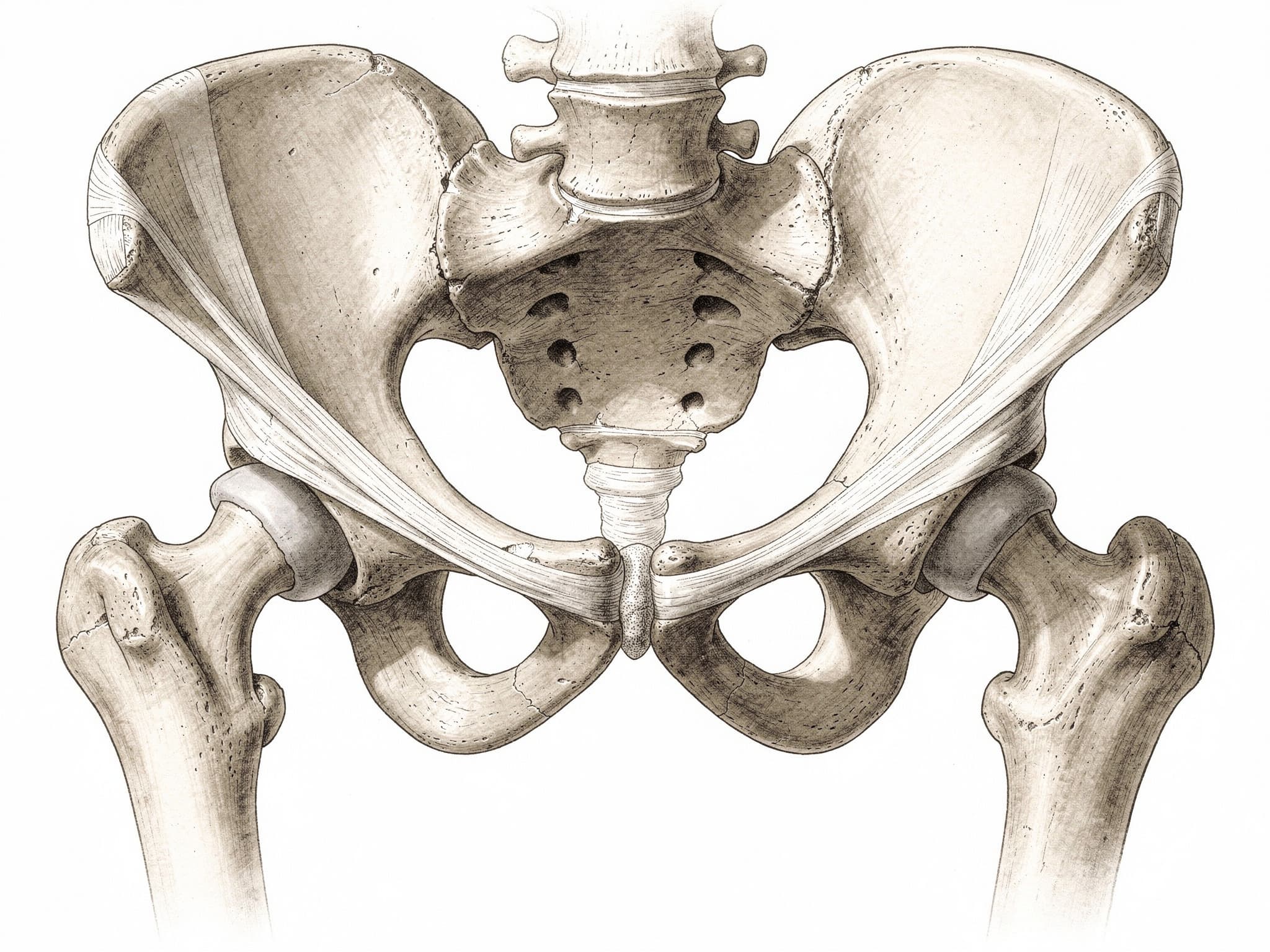
The adductors — adductor longus, adductor brevis, adductor magnus, gracilis, and pectineus — are the most consistently underassessed muscles in pelvic stability. They are regarded primarily as hip adductors, not as pelvic stabilisers. This is incorrect. The adductor magnus, through its attachment at the pubic ramus and its fascial connection to the pelvic floor, is a primary compression generator across the pubic symphysis. The adductor longus and brevis provide the pubic ramus with tensile restraint against lateral shear. When these muscles are inhibited by a withdrawal reflex — from an inguinal hernia, an inguinal scar, or a lower abdominal afferent source — the pubic symphysis loses its primary muscular support. The osteitis pubis pattern that develops is a consequence of this mechanical failure, not an independent pathology.

The Adductors as Pelvic Stabilisers: What Standard Assessment Misses

The adductor group is supplied by the obturator nerve from L2-L4, with the adductor magnus additionally receiving sciatic nerve supply at L4-S1. Their 50Hz resting tone, maintained through the myotatic reflex arc, provides the pubic symphysis with dynamic compression and the medial femoral shaft with postural control. In walking and running, the adductors control abduction — they are eccentrically active during the stance phase, preventing excessive lateral pelvis shift. When their motor neuron supply is reduced by a withdrawal reflex at the L2-L4 cord level, this eccentric control is lost. The pubic symphysis is exposed to uncontrolled shear. The adductor tendon origin at the pubic ramus absorbs the load the muscles should have managed eccentrically. The patient presents with adductor tendinopathy, osteitis pubis pattern pain, or chronic groin ache — all of which are structural consequences of the adductor motor neuron failure.

The inguinal region is one of the most mechanoreceptor-rich areas in the body. The inguinal canal, inguinal ligament, round ligament in females, and spermatic cord structures in males contain afferent fibres that project to the L1-L2 cord level. Any afferent irritant in this region — a subclinical inguinal hernia, a previous hernia repair mesh, an inguinal lymph node under pressure, or a groin scar — generates withdrawal reflex activity at L1-L2 that, via propriospinal tracts, inhibits the adductors at L2-L4 and the lower abdominals at T12-L1. The clinical consequence is the characteristic combination seen in sportsman's hernia presentations: adductor inhibition, lower abdominal inhibition, and the inguinal pain that is their shared afferent source.

"The adductors are not simply hip adductors. They are the primary compression generators across the pubic symphysis. When they are inhibited — by an inguinal hernia, a scar, or a lower abdominal afferent source — the pubic symphysis is mechanically unsupported. What follows is not a coincidence. It is a predictable structural consequence of a neurological failure at the obturator nerve origin."

What Is Driving the Inhibition

The afferent sources most consistently inhibiting the adductors in groin pain patients include:

  • Inguinal hernia — subclinical and clinical: An inguinal hernia — even one that has not yet produced a palpable lump or classic groin bulge — generates persistent afferent input from the inguinal canal mechanoreceptors. This input arrives at L1-L2 and inhibits the lower abdominals and adductors via propriospinal pathways. A patient with adductor tendinopathy who has a subclinical posterior inguinal wall defect has an afferent source driving their adductor inhibition that will not be identified by ultrasound of the adductor tendon. It requires inguinal examination and PMT afferent challenge.
  • Previous hernia repair mesh: Mesh repair of inguinal hernias creates a permanent foreign body in the inguinal canal. As the mesh integrates, it generates mechanoreceptor signals from the surrounding fibrous tissue response. In some patients, this signal is sufficient to maintain low-level withdrawal reflex inhibition of the ipsilateral adductors and lower abdominals. A patient with persistent groin pain following mesh repair who has not improved with standard rehabilitation should have the mesh site assessed as a primary PMT challenge.
  • Lower abdominal wall scars: Scars from appendicectomy, Pfannenstiel incision, laparoscopic port sites, or any lower abdominal surgery generate mechanoreceptor signals that, as they mature, inhibit the lower abdominals and adductors. The adductor inhibition is frequently more prominent than the abdominal inhibition in these presentations — the propriospinal projection from L1-L2 to L2-L4 makes the adductors more vulnerable to remote lower abdominal scar afferents.
  • Lumbar disc afferents at L2-L3: The obturator nerve derives from L2-L4. A disc or facet irritant at L2-L3 generates withdrawal reflex activity that directly reduces adductor motor neuron output. Groin pain with adductor involvement in a patient without inguinal pathology should always include lumbar spine PMT assessment at the L2-L3 level.

The Software Test: Precision Muscle Testing

PMT for groin pain involves testing each adductor individually for the integrity of its obturator nerve motor neuron supply. The adductor longus, adductor brevis, gracilis, and adductor magnus are tested in specific positions that isolate each from the others. The pattern of inhibition is mapped — which adductors, which side, which cord levels — and the lower abdominals are tested simultaneously, as they share the inguinal afferent pathway. With the pattern established, the inguinal canal and inguinal ligament are challenged directly — applying gentle mechanical input to the inguinal canal while immediately retesting the inhibited adductors. When the inguinal challenge restores adductor tone, the inguinal source is confirmed. Lumbar disc levels at L2-L3 are challenged if the inguinal source does not fully restore the inhibition pattern.

In patients with an identified inguinal source, the adductor tone restoration following the afferent challenge is typically complete and immediate. The clinical significance is immediate: the load-transfer mechanism across the pubic symphysis is restored, and the mechanical rationale for adductor tendinopathy and osteitis pubis pattern pain is removed. Management of the inguinal source — whether surgical for a true hernia, manual for inguinal ligament stress, or scar-based for a previous repair site — is the primary intervention, not the adductor tendon loading programme that would conventionally follow.

Clinical Takeaways

  • Adductor tendinopathy without inguinal assessment is incomplete management: The inguinal canal is the primary candidate afferent source for adductor inhibition. A patient with adductor tendinopathy who has not had a PMT inguinal challenge has not had a complete neurological assessment.
  • Subclinical inguinal hernias are a clinically significant afferent source: A hernia does not need to be palpable or symptomatic as a hernia to generate sufficient mechanoreceptor activity to inhibit the ipsilateral adductors. Inguinal examination in all groin pain patients — with specific attention to the posterior inguinal wall — is a necessary component of the assessment.
  • Osteitis pubis is a mechanical consequence of adductor inhibition: The pubic symphysis degrades under uncontrolled shear when the adductors are inhibited. Treating the symphysis directly — with injection or rest — does not restore adductor tone. The symphysis can only recover normal loading when the muscles compressing it are functioning normally.
  • The adductors and lower abdominals share their afferent vulnerability: The inguinal withdrawal reflex inhibits both groups simultaneously. A patient with concurrent adductor weakness and lower abdominal weakness in the same-side pattern has a strong clinical signal pointing to an inguinal source. Both groups restore together when the inguinal source is correctly challenged.

Groin pain is not an adductor problem. It is an inguinal afferent problem expressing at an adductor tendon.

The adductors are inhibited because an inguinal source is generating a withdrawal reflex that removes their motor neuron supply. Remove the source, restore the adductors, and the pubic symphysis is protected again. The groin pain resolves because the mechanical failure that caused it no longer exists.

Learn to apply Precision Muscle Testing in your practice. Explore the Afferentology Clinical Residency. →

Groin PainAdductor InhibitionInguinal HerniaPelvic StabilityPrecision Muscle TestingWithdrawal Reflex