Moving Beyond "Trial and Error": The Case for Clinical Precision in Acute Pain
From Guesswork to Certainty: How Systematic Evaluation Transforms Patient Outcomes
In modern healthcare, we have become surprisingly comfortable with the "trial and error" approach. Often, even well-intentioned "evidence-based" medicine translates into a "suck it and see" protocol: a series of 12 visits, a prescription to manage the symptoms, and a hope that the patient falls into the statistically successful majority. While statistics are useful for populations, they offer little comfort to the individual patient in acute distress.
We wouldn't accept a "wait and see" approach from a structural engineer or a mechanic—we expect them to find the specific fault and fix it. Why should we hold our healthcare providers to a lower standard of precision?
The Systematic Alternative: Identifying the Faulty Loop
It doesn’t have to be a guessing game. When we apply the principles of Afferentology, we shift from managing a diagnosis to evaluating a system. By using a method of systematic evaluation, we can move past the "pop and pray" mentality and identify the exact neurological "software" glitch preventing the body from stabilizing itself.
Case Study: Acute Lumbar Instability
Consider a recent patient who arrived with acute low back pain that had been steadily worsening for a week. He was walking with significant difficulty and experiencing referred pain in the right testicle and the right SI/gluteus maximus region.
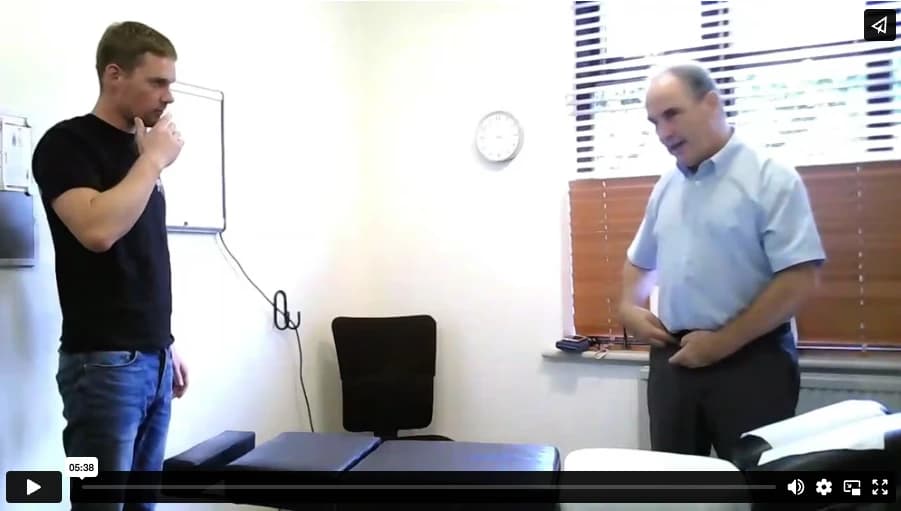
In the video (above), you can observe the diagnostic process in real-time. Instead of general manipulations, we used Protective Reflex Testing to work out exactly which afferent signals were corrupted. In just five minutes, the source of the inhibition was identified and neutralized.
Why Principles Outperform Protocols
I am not suggesting that every case is resolved in five minutes; however, I am suggesting that the Afferentology principles upon which this testing is based never fail to provide clarity. By restoring the 50Hz resting tone of the nervous system, we allow the "hardware" of the spine and muscles to function as they were designed.
When we stop treating every patient as a statistical average and start treating them as an individual system, the "pop and pray" era ends, and true clinical mastery begins.