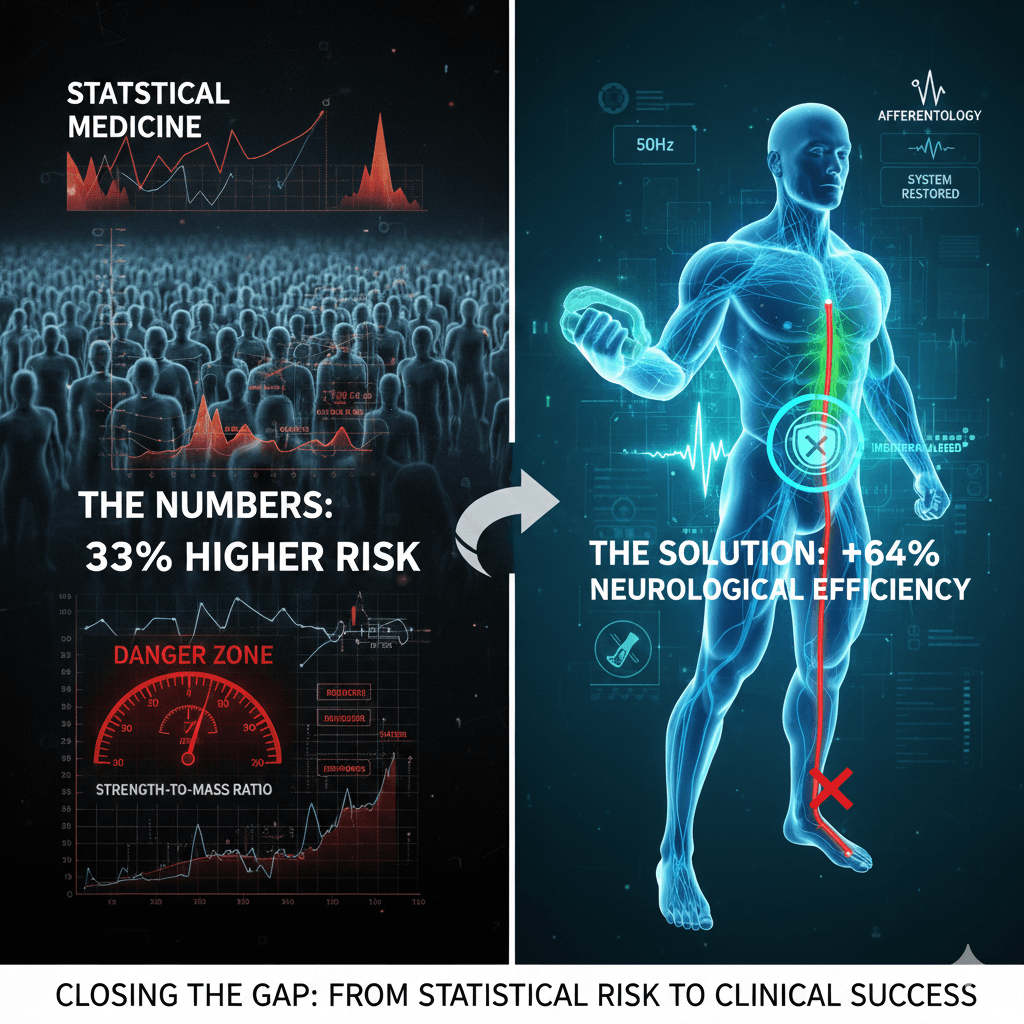
The research is undeniable: your strength is a better predictor of how long you will live than your blood pressure or your cholesterol. As we have seen in the data from the UK Biobank and The Lancet, muscle weakness isn't just a sign of aging—it is a primary driver of systemic decline.
But for the clinician, a statistical risk is only half the story. The real challenge is: What do we do when the strength is missing?
The Software Reset: Beyond Hypertrophy
Traditional approaches prescribe more "hardware" work—resistance training and protein. Yet, for many, the gym provides no relief because the brain has "unplugged" the equipment. This is where Protective Reflex Testing changes the game.
"If a patient’s strength is in the 'danger zone,' we don't ask how much they can lift; we ask why the brain has turned down the volume."
The Afferentology framework looks for the "Nail in the Foot"—the hidden surgical scar, the dental amalgam, or the old injury site that is sending a constant stream of "threat" data to the brain. This is the Withdrawal Reflex in its most subtle, chronic form.
When we find and neutralize that aberrant input, the change is instantaneous. We aren't building new muscle in five minutes; we are restoring the cortical drive. We are essentially re-establishing the connection between the motor cortex and the muscle fibres, turning a "software glitch" back into a high-performance system.
The Practitioner’s New Standard
The studies we have reviewed prove that increasing a patient's strength is more than just a biomechanical win—it is a survival win. By moving away from the "pop and pray" method and adopting a systematic evaluation of the afferent system, you stop managing symptoms and start optimizing the very foundation of human life.
- The Goal: Transition from managing "Hardware" to repairing "Software."
- The Result: Instantaneous restoration of inhibited muscle function.
- The Outcome: A 64% increase in functional strength and long-term resilience.
We have the evidence. We have the tools. It is time to treat strength not as a fitness goal, but as the primary vital sign of a resilient nervous system.