Chronic Fatigue and the Muscle–Adrenal Reflex
Chronic fatigue is one of the most poorly explained presentations in modern practice. Patients are told their adrenal glands are exhausted, their cortisol is dysregulated, their mitochondria are underperforming. The investigations come back borderline. The supplements help a little. The fatigue remains.
Patients are told the problem is stress but stresses are part of life and stress is never a problem if our body is strong enough to cope and fight back. This is where we need to look at resilience and the ability of the body to produce the hormones that create drive, enthusiasm, stamina and endurance. The best known of these are adrenalin and noradrenalin, both come from the adrenal glands.
The Muscle–Adrenal Reflex: What the Research Established
In 1991, Victor and colleagues(1) recorded adrenal sympathetic nerve activity in anesthetised rats during electrical stimulation of the tibial nerve — the nerve carrying sensory signals from the calf musculature to the spinal cord. The result was unambiguous: static muscle contraction reflexly increases sympathetic nerve activity to the adrenal gland. The signal pathway runs from the muscle spindles, through the group III mechanoreceptor afferents, into the spinal cord, and out again as sympathetic discharge to the adrenal medulla.
When neuromuscular blockade was applied, eliminating the contractile signal while preserving the afferent pathway, adrenal sympathetic nerve activity dropped. When the afferent input was present, the adrenal gland was driven. When it was absent, the drive ceased.
The adrenal gland was responding precisely to the neurological input it was receiving.
This is important because we are often told that the fight or flight reflex is an emotional response, but this research confirms it is also a physical, neurological one.
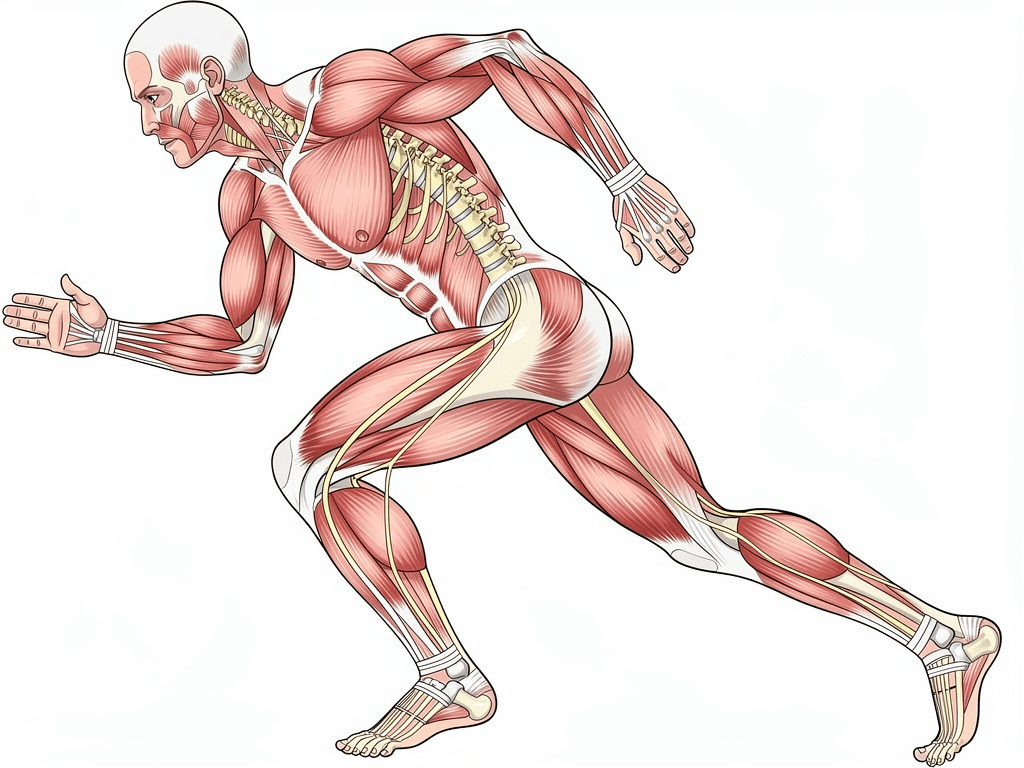
If the tiger jumps out and is about to attack you, you run. As you run, the contraction of your calf muscles sends sympathetic stimulation to the adrenal glands, producing adrenalin to help you run even faster. It's part of our survival system. It's also part of the reason exercise helps you feel better — the muscle contraction releases feel-good hormones and stimulates the brain, which is why people get hooked on running (the runner's "high"). But the important part of this equation isn't the one hour a day you spend exercising — it's the state of your muscle in the 23 hours you don't. Fortunately, you don't need to exercise around the clock, because resting muscle tone already does this job for you. Even at complete rest, your motor neurons are still firing into the muscle at a low background rate, and the muscle spindles — which sense tension in the muscle — are still sending signal back up the chain. That baseline loop is what's driving adrenal output all day, not just during your workout.
How much signal gets through, though, depends on the state of that motor neuron. If it's inhibited, its firing rate drops below normal, muscle tension falls, and adrenal sympathetic drive falls with it.
The Clinical Picture This Creates
A patient with inhibited muscle tone is not simply weak. Their nervous system has reduced its output to the adrenal medulla. Adrenaline and noradrenaline release is blunted at baseline. The downstream consequences are predictable: persistent fatigue that does not resolve with rest, reduced capacity to sustain effort, flat motivation, poor stress tolerance, and a subjective sense of being “switched off.”
Standard treatment approaches aim at the adrenal gland directly: adaptogenic herbs, cortisol support, mitochondrial supplementation. These are hardware solutions to a software problem. The adrenal gland is not depleted. It is not receiving adequate sympathetic stimulation.
Clinical Takeaways
- The adrenal gland fires in response to muscle spindle afferent input. This is a spinal reflex, not just an emotional or psychological event. Inhibiting the afferent signal inhibits adrenal sympathetic drive.
- Unexplained fatigue is a muscle tone question before it is an adrenal question. If the deep musculature is neurologically inhibited, the sympathoadrenal reflex is suppressed — and no amount of adrenal support will restore a signal that is not being sent.
- Restoring muscle tone restores the reflex. When the afferent irritant driving the withdrawal is identified and removed, muscle tone returns — and with it, the sympathetic drive to the adrenal gland. The fatigue resolves not because the adrenal gland was treated, but because the input it depends on was restored.
Chronic fatigue that does not respond to rest, nutrition, or adrenal supplementation may be a neurological problem.
The muscle spindles that should be driving sympathoadrenal output have been silenced by an afferent source the patient does not know exists and no investigation has looked for.
Find the muscle inhibition, remove whatever is causing it, restore the tone — and watch the energy return. When the software is updated, the output improves.