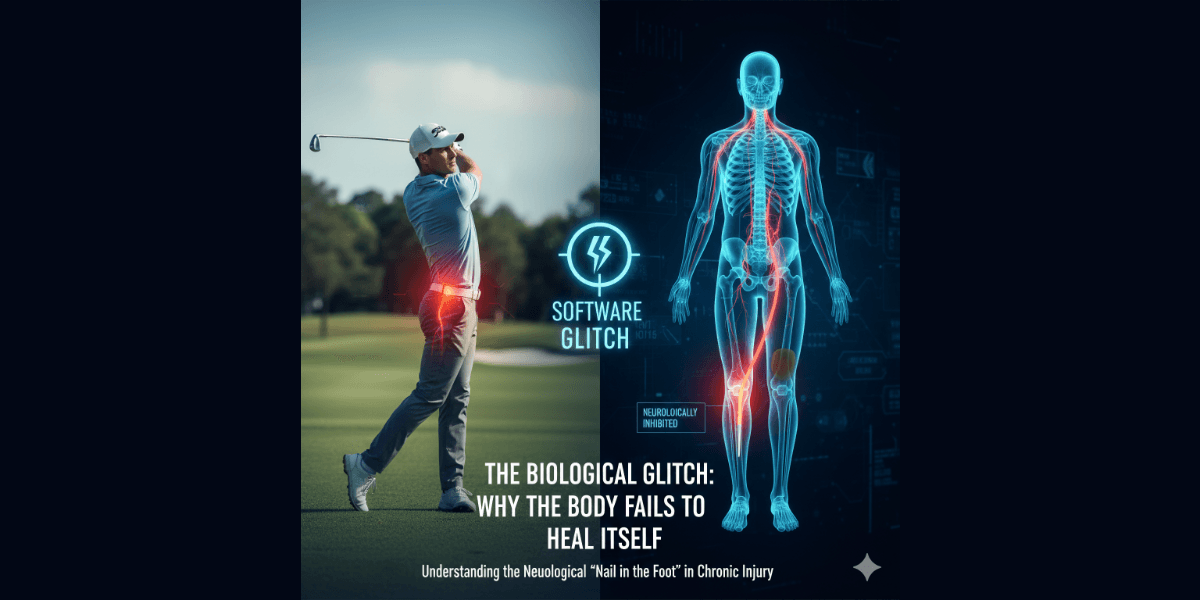
The human body is a marvel of self-sustaining ingenuity. Under normal conditions, damaged tissues are repaired automatically—no exogenous intervention required. Even a fracture, a significant structural failure, typically heals within 12 weeks. However, when an injury persists beyond this three-month window, we enter the costly realm of chronic pain.
Traditional medicine often focuses on the diagnosis of the injured "hardware"—the torn ligament or the bulging disc. Yet, these diagnoses frequently fail to answer the most critical clinical question: Why has the body’s innate healing response stalled? From elite athletes like Tiger Woods to the everyday patient, the failure to heal is rarely a lack of rest or exercise; it is a failure of the neurological software.
The Anatomy of Injury: Speed vs. Force
Most musculoskeletal injuries are, at their core, joint injuries. A joint is a delicate balance: two bones anchored by ligaments and governed by muscles. We sustain injuries when our muscles fail to react with the necessary speed and force to counteract an external load.
If the muscles are firing correctly, they absorb the force and protect the joint. If they are neurologically inhibited, the joint bears the brunt of the impact. This inhibition is the "switch" that the nervous system uses to turn off various muscles, often as a protective measure that has outlived its usefulness.
The Persistence of Muscle Inhibition
Inhibition is a vital part of movement—when a bicep contracts, the tricep must be inhibited to allow motion. This is reciprocal inhibition. But what happens when this inhibition becomes permanent?
The "Nail in the Foot" Analogy
Imagine stepping on a nail. Instantly, your hamstrings are facilitated to pull your foot away, while your quadriceps are inhibited to allow that movement. This is a life-saving reflex. However, if that "nail" (an afferent irritant) is never removed, the quadriceps remain inhibited and weak. The patient may feel "normal," but their knee joint is now unprotected and prone to chronic failure.
In a clinical setting, these "nails" are often hidden in plain sight. Because our skin can detect the movement of a single hair, even non-painful stimuli can disrupt the 50Hz resting tone of the nervous system. Common irritants include:
- Surgical scars (corrupted sensory data)
- Dental amalgams or metal crowns
- Body piercings (e.g., a belly button piercing can chronically inhibit spinal extensors)
The Impact on the Lumbar Spine
Consider a patient with chronic low back pain. If a piercing or scar in the abdominal region is constantly activating the abdominals via the withdrawal reflex, the spinal extensors—the muscles meant to hold them upright—will be reciprocally inhibited.
The patient doesn't feel "weak" until they lift a heavy object. At that moment, the inhibited extensors fail to stabilize the vertebrae, leading to a sprain. No amount of core strengthening will fix this until the aberrant afferent input is identified and neutralized. The "software" must be updated before the "hardware" can heal.
Mastery Through Precision Testing
For the chiropractor or health professional, the key to unlocking these "unhealable" cases is Protective Reflex Testing. By identifying which muscles are inhibited, we can track down the specific afferent source—the neurological "nail"—that is blocking the healing response.
Traditional protocols that treat only the site of pain are merely managing symptoms. Afferentology offers the framework to restore the system's integrity.